Personalized Attention +44 151 947 0713
 SHIPPING TO ALL

 9/10 Rating
 SALE TO MINORS PROHIBITED

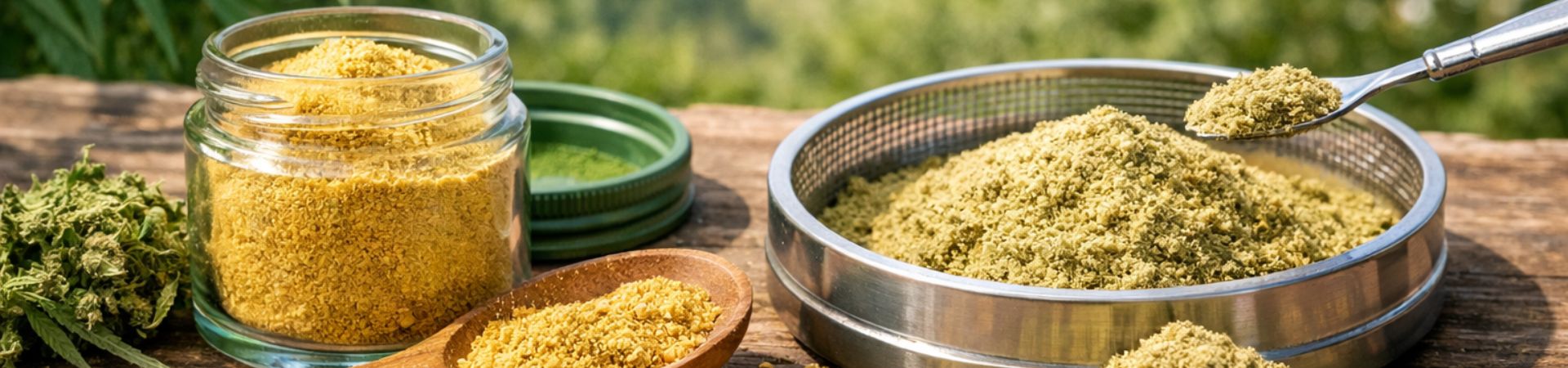
The difference between dry sift and pollen lies fundamentally in the method of trichome separation and how each term is understood within the industry. While dry sift is associated with dry sieving, pollen is often used more generally to refer to separated resin or trichomes. In technical contexts, it is advisable to distinguish it from other extractions such as bubble hash, which is obtained using water and ice.
In Spain, within the world of extractions, the difference between dry sift and pollen continues to generate questions among growers and enthusiasts, especially when comparing potency, cleanliness, yield, and aromatic profile. The GB blog already distinguishes Dry Sift as dry sieving and Bubble Hash as extraction with water and ice.
Differences in techniques between Dry Sift and Pollen
Dry Sift and Pollen: Which method preserves more trichomes?
Terminological confusion in the Spanish market is also common. In many cases, pollen is related to a dry extraction similar to dry sift. In other contexts, it is often used to describe a more generic or less refined resin, especially when it is later presented in formats such as hashish plates.
Dry sift works through vibration or dry sieving to separate trichome heads, while pollen made with water and ice corresponds to a different extraction. This extraction is closer to bubble hash. Growbarato specifically differentiates both methods in its content on types of hashish and extractions.
Measurements and comparisons carried out in these types of processes usually show clear differences in composition:
- Quality Dry Sift: 80–95% intact trichome heads
- Traditional Pollen / water and ice extraction: 60–75% trichome heads with a higher presence of microscopic matter
- Maximum documented potency: Dry sift up to 68% THC versus pollen up to 42% THC.
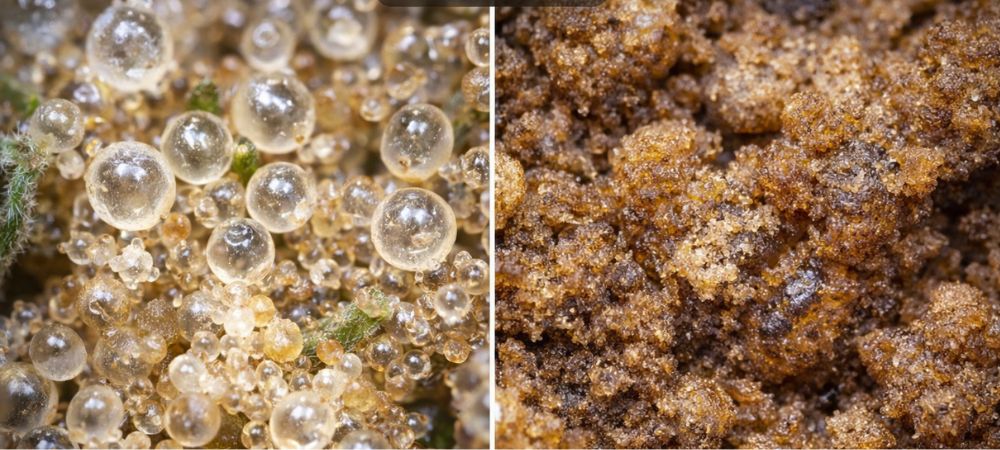
Dry sift and pollen: Which method preserves terpenes better?
The water and ice process usually stands out for its ability to better preserve certain volatile aromatic compounds. Therefore, when comparing pollen made with cold water to a very clean and potent dry sift, a difference is seen. Often, the former offers a more expressive organoleptic profile. In contrast, the latter usually stands out more for its purity and concentration.
This difference helps explain why many experienced consumers especially value the aromatic profile of certain pollen or bubble hash-type extractions, compared to dry sift, which is more focused on potency and mechanical separation.
Yield and efficiency: Dry Sift vs. Pollen
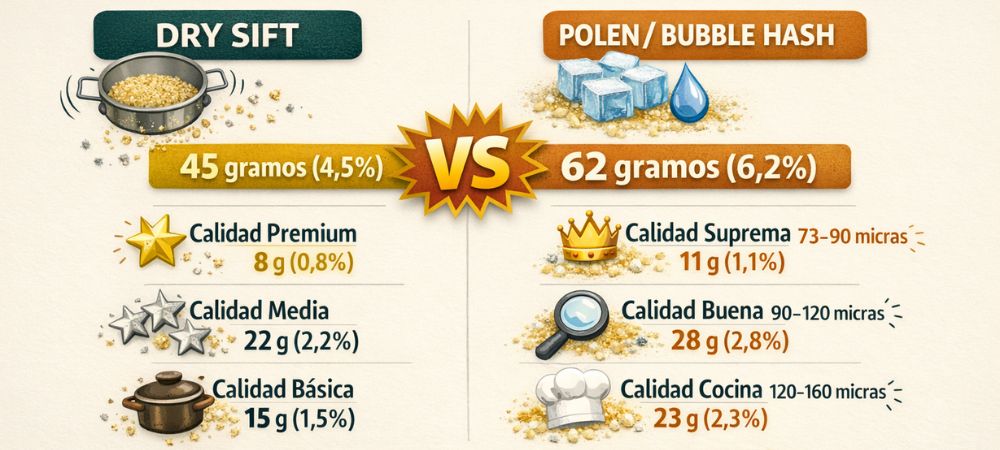
Systematic analyses of 1000 grams of identical material processed with both methods yield interesting results in terms of total yield and quality classification.
Dry Sift Yields:
- Total: 45 grams (4.5%)
- Premium quality (6 stars): 8 grams (0.8%)
- Medium quality (4 stars): 22 grams (2.2%)
- Basic quality (2 stars): 15 grams (1.5%)
Pollen / Bubble Hash Yields:
- Total: 62 grams (6.2%)
- Supreme quality (73–90 microns): 11 grams (1.1%)
- Good quality (90–120 microns): 28 grams (2.8%)
- Cooking quality (120–160 microns): 23 grams (2.3%)
Key factors to maximize your extraction
Research and practical experience agree that well-cured and properly stored material significantly improves the final result. In many cases, working with flowers cured for 6 to 12 months and good resin extraction material allows you to obtain:
- 15% more yield in dry sift
- 23% more yield in pollen
- Greater trichome stability during processing
In addition to curing, other factors such as the state of the plant material, working temperature, ambient humidity, and the quality of the equipment used also influence the result.
Do you live in a dry, temperate, or humid area? How each method adapts in Spain
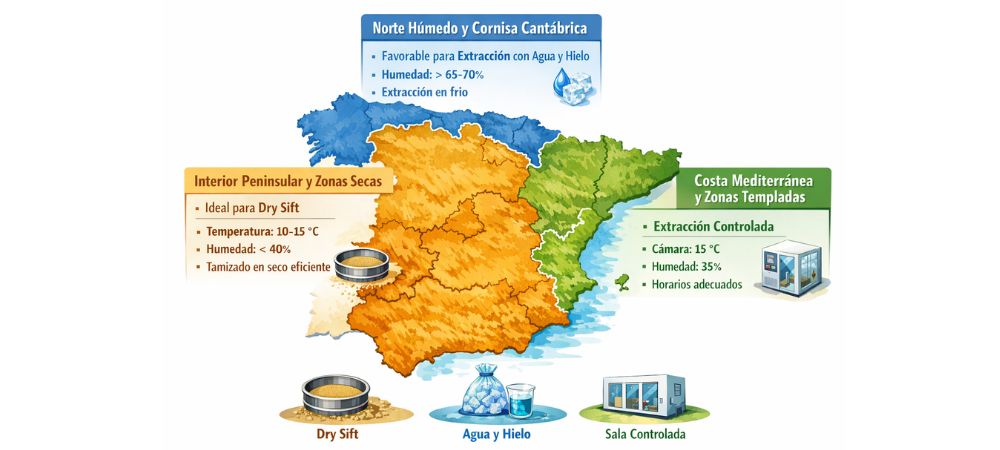
Peninsular interior and dry areas: the ideal terrain for Dry Sift
The areas of the peninsular interior, with drier environments and relatively low humidity for much of the year, offer very favorable conditions for working with dry sift. In provinces with a continental or semi-arid climate, dry sieving can be performed with better results when a controlled temperature and contained humidity are maintained.
In this context, processing the material at around 10–15 °C and with humidity below 40% helps to achieve a cleaner and more effective separation.
Mediterranean coast and temperate zones: controlled extraction
In areas like the Mediterranean coast, where humidity can vary greatly depending on the time of year and time of day, it is advisable to work in more controlled conditions. Here, the solution involves adapting the workspace:
- Controlled chamber: constant 15 °C
- Stable humidity: 35%
- Processing at specific times to avoid humidity spikes
Humid north and Cantabrian coast: favorable environment for Pollen
In the north of Spain and other areas with high humidity, water and ice extractions usually perform especially well. When the environment frequently exceeds 65–70% humidity, working with resin extraction bags and very cold water can be more stable. In addition, it is also usually more predictable than dry sieving, as well as favoring good preservation of the aromatic profile.
Improving quality: advanced techniques for Dry sift and Pollen
Static Tech: improve your dry with electrostatic charge
The electrostatic technique or Static Tech has become one of the most interesting improvements for raising the quality of dry sift. Applied correctly, it allows for better separation of unwanted plant matter and concentrates the trichome heads with superior cleanliness.
Among its main advantages are:
- Conversion of material from 3 stars to 5–6 stars
- 95% effectiveness in separation
- Critical temperature: 13 °C
- Reduced investment with much more professional-looking results
Thermal fractionation: separate and boost your Pollen
In water and ice extractions, temperature fractionation helps to separate the resin. Thus, different fractions are obtained according to the predominant compound.
- First fraction (4 °C, 5 min): volatile terpenes
- Second fraction (8 °C, 10 min): main cannabinoids
- Third fraction (12 °C, 5 min): heavier cannabinoids
Each fraction can offer different nuances in aroma, texture, and final behavior, which opens the door to a more precise classification of the product.
Equipment needed to achieve high-level extractions
Key tools for Dry Sift: from novice to expert
- Starter kit: screens of varied micron size
- Intermediate level: vibration system + temperature control
- Professional: electrostatic separator with higher processing capacity
Ideal equipment to produce quality Bubble Hash
- Essential: multi-micron extraction bags
- Recommended: extraction washing machine that improves consistency
- Compact alternative: Pollen Maker-type systems for small quantities
In the GB Spain ecosystem, Dry Sift continues to be identified as a dry extraction with sieves. In contrast, Bubble Hash is associated with the use of water and ice. This is why this division of equipment fits well with the terminology already used by the brand.
Investment vs. yield: Dry sift or Pollen for better ROI?
How much each technique costs and how much it yields
Dry:
- Initial investment: €20–250
- Processing: fast, more agile than working with water
- Product value: high when the selection comes out clean and well-sieved
- Estimated ROI: 6–8 months
Pollen:
- Initial investment: €150–650
- Processing: medium, more dependent on equipment and process
- Product value: competitive due to yield and aromatic profile
- Estimated ROI: 6–8 months, thanks to the higher total volume
Quick guide to choosing between Dry and Pollen
The choice between dry and pollen depends on several factors: climate, available equipment, working time, and the final goal of the extraction.
Choose Dry when:
- You live in areas with less than 50% average humidity
- You are looking for maximum potency and cleanliness
- You value fast processing
- You have controlled space
Opt for Pollen when:
- Your area has more than 65% humidity
- You prioritize a more complex terpene profile
- You are looking for higher total yield
- You prefer a product with good stability and classification by fractions
Get the best results according to the climate
At GB The Green Brand Spain, we recommend choosing the method according to the area in which you work, the actual conditions of your space, and the equipment you have on hand.
You don’t work the same way in the peninsular interior, on the Mediterranean coast, or in the humid north. That context can greatly influence the final result.
Achieving good extractions requires practice, consistency, and an environment that is as controlled as possible.
Both dry and pollen have their place. Knowing well when and how to use each one allows you to get more out of the material and better adapt to the growing conditions in Spain.
Legal notice
Content is strictly educational and informative. In Spain, cannabis, its resin, and its extracts are subject to legal restrictions. That is why any related activity must always comply with current regulations.