Personalized Attention +44 151 947 0713
 SHIPPING TO ALL

 9/10 Rating
 SALE TO MINORS PROHIBITED

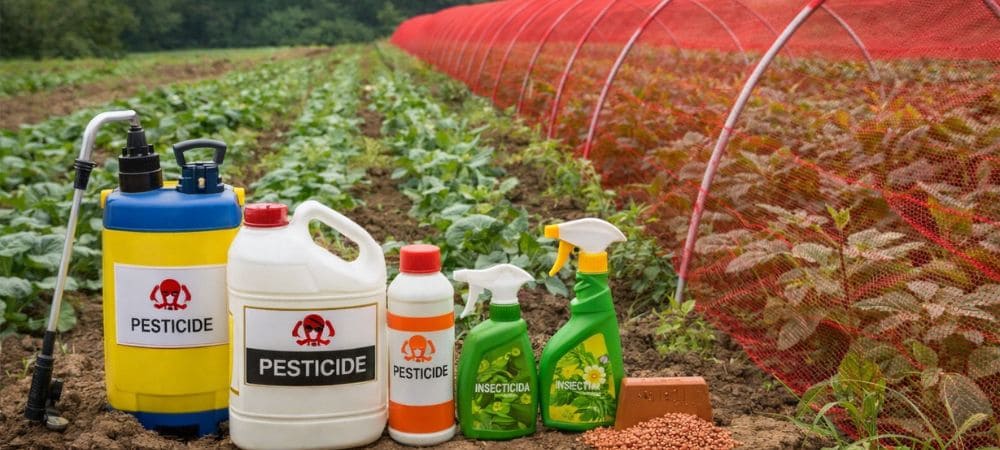
Pest control and reducing pesticide use have been, for decades, a kind of war of attrition. An insect appears, a chemical product is applied; the insect returns, the dose is increased; costs rise, effectiveness drops, and fields end up filled with residues no one wants.
In that context, the fact that a serious study shows that simply changing the color of an agricultural net can reduce insecticide use by up to 50% is not a curious anecdote—it is a clear wake-up call.
This is not about futuristic theories or miracle solutions. It is about a real experiment, in real crops, with real pests, addressing a problem that farmers around the world know all too well.
A simple study that tackles the problem from a different angle
The research was conducted by the University of Tokyo in collaboration with the Kyoto Agricultural Center. Their approach was as simple as it was unconventional: instead of searching for a new substance to kill insects, they chose to observe how pests interact with their visual environment.

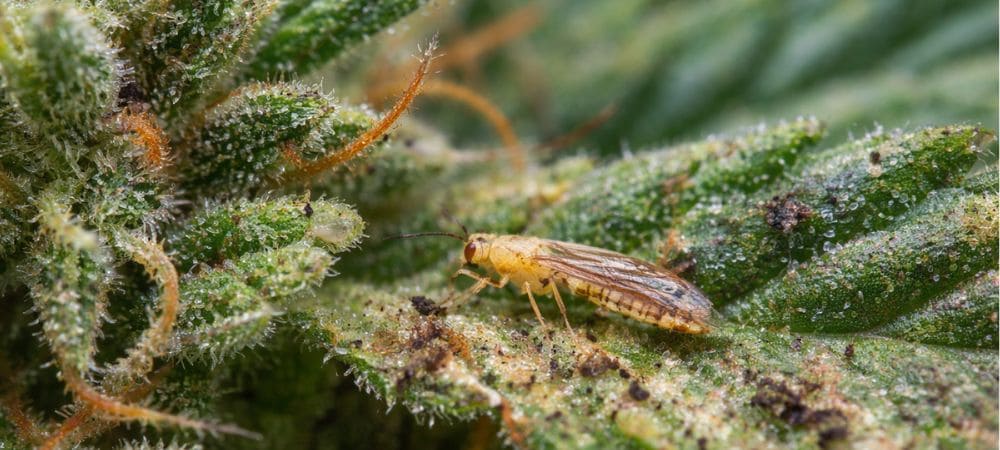
The goal was not extermination, but rather to interfere with insect behavior. To do so, they chose a very specific yet representative scenario: Kujo leek crops, a Japanese variety similar to green onions, particularly vulnerable to a well-known pest, onion thrips. This insect not only damages leaves while feeding but also acts as a virus vector, forcing frequent pesticide treatments.
Why thrips are the perfect enemy for this experiment
Thrips are not just any pest. They are small, persistent, and extremely difficult to control using chemicals alone. Their rapid life cycle and high adaptability push many growers into a vicious cycle: more thrips lead to more treatments, and more treatments eventually create resistant populations.
For this reason, any method that allows growers to reduce pesticide use without losing effectiveness against this insect has enormous value. If it works with thrips, it is reasonable to assume it may also work with other pests that exhibit similar behavior.
Before discussing specific solutions, it is important to put the problem into context. Not all pests behave the same way or exert the same level of pressure on crops. Proper identification is the first step toward implementing more effective pest control strategies that are less dependent on pesticides.
| Common crop pests and how to identify them | |||
|---|---|---|---|
| Pest | How to identify it | Typical damage | Critical stage |
| Thrips | Silvery streaks on leaves, small elongated insects | Leaf damage and virus transmission | Growth and pre-flowering |
| Whitefly | Small white insects that fly when the plant is disturbed | Weakening due to sap extraction | Indoor and greenhouse |
| Aphids | Visible colonies on shoots and stems | Deformation and plant stress | Spring |
| Spider mites | Yellow speckling and fine webbing | Reduced vigor and yield | Heat and dry conditions |
What was actually tested in the field
One of the study’s greatest strengths is that it did not simply compare “net versus no net.” Researchers analyzed different agricultural net colors—white, black, and red—as well as different mesh sizes, some even larger than the insect itself.
This is important because it rules out a simplistic explanation: the observed effect could not be attributed solely to the net acting as a physical barrier. In many cases, thrips could pass through the mesh without difficulty, yet their presence in the crop still decreased when red netting was used.
This detail makes the experiment far more compelling: if the insect can pass through but behaves differently, the key lies in how it perceives its environment, not in blocking its access.
Once the type of pest and its behavior are identified, the next step is understanding which pest control tools are available and where a solution like red netting fits in. Not all methods work the same way, nor do they have the same long-term impact.
| Pest control methods: when and how to use them | |||
|---|---|---|---|
| Method | Type | Advantages | When to use it |
| Red agricultural netting | Preventive | Reduces pesticide use without chemicals | From the start of the crop cycle |
| Potassium soap | Organic | Low environmental impact | At first signs of infestation |
| Neem oil | Organic | Broad spectrum | Prevention and light control |
| Chemical insecticides | Corrective | Fast-acting | Severe infestations |
Insect vision: the key factor that explains everything
This is where one of the most fascinating—and least known outside scientific circles—aspects of the study comes into play. Insects do not see the world the way humans do. Their visual systems are adapted to detect specific contrasts and wavelengths that help them locate food, shelter, or mates.
The color red, for many insect species, falls outside their effective range of perception. It is not that it “bothers” them or that they consciously avoid it; rather, they simply do not interpret it as a clear signal.
In a crop setting, this has very practical consequences. The insect loses visual references, becomes less oriented, reduces its activity on the plant, and ultimately causes less damage.
This is not a classic repellent effect, but rather a disorientation phenomenon that reduces insect–plant interaction.
The evidence is clear
The data from the study were striking. Crops protected with red nets required between 25% and 50% less insecticide compared to unprotected crops or those using nets of other colors.
Moreover, this reduction did not come with an increase in plant damage. On the contrary: crops showed greater stability, less stress, and more uniform development. All of this was achieved without constant treatments and without negatively affecting the crop’s microclimate.
This is a key point because one of the major issues with some traditional nets is that they reduce ventilation or light penetration, creating excessive humidity and promoting fungal diseases. In this case, the protective effect did not rely on closing off the crop further but on visually confusing the pest.
Why this approach represents a shift in pest control
Most pest control strategies focus on acting after the problem appears. The Japanese study proposes something different: intervene before, modifying the environment so that pests do not behave as they normally would.
This has several important implications. First, it does not create resistance because there is no direct chemical pressure on the insect. Second, it reduces the need for constant human intervention. And third, it allows growers to reduce pesticide use without requiring a radical change in cultivation practices.
Passive solutions based on insect behavior have greater long-term potential than purely chemical strategies.
The role of color: Not all nets work the same
Another major takeaway from the study is that simply using a net is not enough. Color matters—a lot. White and black nets, widely used, did not demonstrate the same level of effectiveness. Some were even neutral or irrelevant from the perspective of insect behavior.
Red, on the other hand, offered a clear advantage: it did not significantly alter crop light levels, allowed good ventilation, and at the same time interfered with the pest’s visual perception.
What this means for european agriculture
Although the study was conducted in Japan, its implications fit particularly well in the European context. In recent years, regulations on plant protection products have tightened, limiting the number of authorized substances and raising costs.
At the same time, consumers demand products with fewer residues and greater traceability. In this scenario, any system that allows growers to reduce pesticide use without compromising yields becomes a strategic tool, not just an environmental one. Such solutions make the most sense when regulatory and social pressure on pesticide use is high.
This is not a miracle solution
It is important to be clear: red nets do not eliminate all pests nor completely replace other control methods. They are not effective against soil insects, do not solve advanced infestations, and do not compensate for poor crop management.
Their true value lies in prevention. They work best when integrated into a rational management system, combined with monitoring, crop rotation, and, when necessary, targeted treatments.
Their effectiveness increases when used as a first line of defense, not as an emergency patch.
A broader lesson: understand before intervening
Beyond the specific case of the color red, this study delivers an important lesson: often, the problem is not a lack of pesticides, but rather too many shortcuts. Understanding how pests perceive their environment can open the door to simpler, cheaper, and more sustainable solutions.
Reducing pesticide use does not always require large investments or complex technologies. Sometimes it is enough to change the question: instead of asking, “What can I use to kill it?” ask, “How can I make it behave differently?”
The Japanese study shows that pest control can evolve without relying on more chemicals or aggressive solutions. Changing the color of a net may seem like a minor detail, but its cumulative effects are enormous: fewer treatments, lower costs, reduced residues, and more stable crops.
Reducing pesticide use is no longer just an ethical or environmental issue; it is a smart production strategy. And sometimes, the first step is not to add something new, but to look at what already exists from a different angle.



 Add as preferred source in Google