 Personalized Attention +44 151 947 0713
 SHIPPING TO ALL


 9/10 Rating
 SALE TO MINORS PROHIBITED


How do thermal insulators work? Most of us know thermal insulators for their use as construction materials. Thermal insulation is generally placed between two walls with the intention of increasing their insulation capacity. However, it is also used in different ways and in various products, such as refrigerators, air conditioning ducts, industrial machinery, and so on.
It is important to know that any type of material placed in front of an area we want to insulate will act as an insulator; obviously, depending on the material used, the insulation will be greater or lesser.
Examples of insulating materials:
- Aluminum
- Cotton
- Expanded clay (Arlita)
- Hemp
- Wood fiber
- Rock wool
- Polyurethane foam
Different types of insulators
On the market, you can find three types of insulators to prevent heat transfer, each with a specific purpose. On one hand, there are thermal insulators for conduction, on the other, thermal insulators for convection, and finally, thermal insulators for radiation.
Conduction thermal insulator
The most widely used thermal insulator is the one that prevents heat transfer by conduction, or in other words, by contact. This is the most common type and the one we can find in practically every home. As a general rule, it is used as insulation for different types of electronic devices with the intention of preventing heat from transferring from one to another.
Convection thermal insulator
Heat transfer by convection is something that almost all cannabis consumers who have used vaporizers for consumption are familiar with. It involves the transfer of heat through a current of air, gas, or even through liquids. Thermal insulators designed to prevent heat transfer by convection try to prevent that air, gas, or liquid from coming into contact with the desired surface; for this, different types of sprays, foams, and even plastics are used, among others.
Radiation thermal insulator
This type of heat transfer is the one that interests us indoor cannabis growers, since objects that heat up, such as ballasts, light bulbs, and other electronic devices, emanate heat in the form of infrared radiation. Thermal insulators for this type of radiation try to reflect or repel the heat toward a specific area, preventing the protected area from heating up. Generally, a type of metallic material is used, and it is usually installed between floors when building houses or buildings.
Note:
For a thermal insulator to perform its function perfectly, or at least to a high percentage, it is necessary to line the entire grow space without leaving any gaps through which the radiation generated by the various electronic components in the room itself can pass. This includes all walls, windows, doors, and the ceiling.
How do thermal insulators work? | Crop detection
One of the main reasons why authorities discover that an indoor marijuana grow is taking place is due to the heat produced by lighting equipment and other electronic devices. For this, law enforcement and even thieves use different heat detection systems, such as thermal cameras, also known as infrared cameras.
These types of cameras work by reading the wavelength emitted by the object, structure, or living being being analyzed. To understand it in a simpler way, these cameras are capable of detecting wavelengths that the human eye cannot see, as they are in a range undetectable to us. Just as it happens with lighting bulbs, of which we are only able to see part of their spectrum (electromagnetic radiation).
How to make our grow undetectable?
For our grow to be undetectable, regardless of its size, we must ensure that the radiation produced by the luminous bodies (light bulbs) and other electronic devices (ballasts, extractors, etc.) does not reach the walls of the room. To achieve this, a layer made of different types of metal alloys, such as lead and aluminum, among others, must be used.
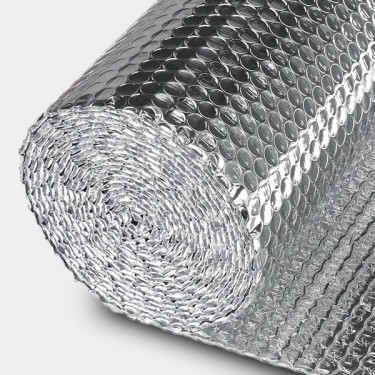
The idea is to completely cover or line the entire grow space that will be used for this purpose (walls, windows, doors, and ceiling) with a paper specifically designed for it. This type of paper is called anti-detection reflective paper or thermal insulating paper and is usually made with the materials we mentioned earlier. In addition, to achieve a better insulating effect, they are also formed by an intermediate or external layer (depending on the model) of air bubbles, which help keep the room protected against external thermal fluctuations by up to 15°C.
Our recommendations
Reflective Thermal Insulating Plastic
The reflective paper model designed by Neptune Hydroponics is an excellent alternative for growers who want to thermally insulate their indoor cannabis grow room or space effectively and economically.
In this case, we are talking about a paper that possesses a high percentage of reflection and contains a large number of air bubbles, which help maintain a temperature difference with respect to the outer wall of between 10 and 12°C.
Dis Swat Thermal Insulator
Dis Swat has revolutionized the market since its appearance, helping thousands of growers keep their rooms completely protected from the much-feared thermal cameras.
In this case, we are talking about a type of insulator composed of two external highly reflective sheets and a bubble chamber approximately one centimeter thick, which helps maintain a temperature difference between the wall and the interior of up to 15°C. We also have the possibility of choosing the model with a single reflective side, which is ideal for well-insulated houses.
Dis Swat AUTOFIX Thermal Insulator
The Dis Swat AUTOFIX anti-detection reflective paper is characterized by being designed with an adhesive surface so it can be stuck to the wall or any surface we can think of, easily, simply, and without the need to use duct tape or a stapler for it.
Note:
To achieve perfect insulation, we recommend using Dis Swat AUTOFIX Unions. This product is designed to perfectly seal the joints created when joining different sections of anti-detection reflective paper or thermal insulating reflective paper.






 Add as preferred source in Google


