Personalized Attention +44 151 947 0713
 SHIPPING TO ALL

 9/10 Rating
 SALE TO MINORS PROHIBITED

Knowing the right Big Bud dosage to use isn’t just about looking at how many ml/L the brand recommends, because the format you use, the substrate you grow in, and the stage of flowering also play a role. Applying liquid Big Bud, Big Bud Coco, or Big Bud Powder is not the same, nor does it make sense to treat a crop in soil, coco, hydroponics, or outdoors in the same way.
The reality is that, although all three products belong to the same family and share the goal of supporting floral development, they are not designed for exactly the same thing. The format, concentration, and method of measurement change, and in the case of the coco version, the nutritional approach also changes.
Furthermore, when working within the Advanced Nutrients flowering program, it is also useful to understand how Big Bud fits with Overdrive. Many mistakes do not come from the dosage itself, but from starting too early, extending Big Bud for too long, or overlapping it with products that correspond to a different phase of the crop.
What is Big Bud and what is it used for in flowering?
Big Bud is one of the best-known flowering stimulators from Advanced Nutrients. Its main function is to support the plant during the stage when it begins to form flowers more intensely, providing a combination aimed at promoting floral development, density, and bud volume within a flowering nutrition program.
It is not a complete base, but a supplement that integrates into a broader cultivation chart. In other words, it does not replace the main fertilizer, but is added at a specific time to reinforce the phase in which the plant begins to demand more concrete support.
It is also worth remembering that the published dosage serves as a reference, but does not replace crop observation. Two plants of the same variety, with the same product and in the same substrate, can behave differently if they have different root sizes, different growth speeds, or an unequal nutritional history.
When to use Big Bud in flowering?
Big Bud is designed to accompany the moment when the plant enters fully into floral formation. Its use is normally between week 2 and week 5 of flowering, which is when the crop begins to concentrate energy on the flower structure.
This implies two important things: it makes no sense to use it from the first day of flowering, and it is not advisable to extend it until the end. Big Bud is not a fertilizer for the entire flowering phase, but a product designed for a specific window within early-to-mid flowering.
Differences between liquid Big Bud, Coco, and Powder
Before looking at any chart, it is worth understanding that you are not comparing three identical containers with a different format, but three different ways of working with the same product family. All three share a goal within flowering, but they do not fit the same in all crops, nor are they handled in the same way.
Liquid Big Bud
Liquid Big Bud is the best-known version and the easiest to use for most growers. The dosage is measured in ml/L, mixing is simple, and it is usually the most convenient option when looking for a clear and direct guideline for regular watering.
Another advantage of the liquid format is that it is more practical when you want to make small adjustments between waterings without preparing large amounts of solution. In small crops, individual pots, or manual routines, that flexibility is usually very useful.
Big Bud Coco
Big Bud Coco is the variant specifically oriented to crops in coco fiber. It is not just the name that changes, but the product focus, as it is designed to better fit the particularities of this substrate, where nutrition depends much more on watering and where imbalances are usually noticed sooner.
This difference makes more sense when the coco crop already follows a very marked routine of watering and nutrition. As it is a less absorbent medium than soil, the specific product helps to avoid very general interpretations that usually fail more often in coco.
Big Bud Powder
Big Bud Powder is the water-soluble powder version. In this case, the dosage is measured in g/L, which requires working with more precision. Its great advantage usually lies in the concentration, yield, and cost per liter prepared, but it also requires a little more care when preparing the solution.
It is not necessarily more potent than the liquid, but more concentrated in format. That is why it fits especially well when looking for efficiency and preparing many liters of solution throughout the flowering period.
Comparison of liquid vs. coco vs. powder Big Bud
| Format | Approx. NPK | Dosage | Approx. Price | Price/L prepared | Ideal Substrate |
|---|---|---|---|---|---|
| Liquid | 0-1-3 | 2 ml/L | €25-30 (250 ml) | ~ €0.20/L | Soil / Hydro |
| Coco | 0-4-4 | 2 ml/L | €25-30 (250 ml) | ~ €0.20/L | Coco |
| Powder | High concentration | 0.5 g/L | €40-45 (250 ml) | ~ €0.08 – 0.10/L | Coco / Hydro |
The first thing that usually catches the eye is that, although liquid Big Bud and Big Bud Coco are quite similar in how they are used, the nutritional reading is not the same. The Coco version shows a profile more oriented to that medium, and it makes sense precisely because coco requires much finer management of watering and the nutrient solution. The liquid version, on the other hand, maintains a more versatile profile, which is why it is usually seen as the standard reference within the range.
Big Bud Powder changes the equation more. At first glance, it may seem more expensive in the container, but when you calculate the price/L prepared, the scenario changes quite a bit. That is why this table is not only useful for comparing specifications, but also for answering which format is more cost-effective according to your way of growing.
Big Bud dosage table by substrate and week
The following table is designed to solve one of the most common doubts: it not only compares the dosage of the three Advanced Nutrients Big Bud formats, but also crosses it with the three most common growing media: soil, coco, and hydroponics.
| Flowering Week | Soil | Coco | Hydroponics |
|---|---|---|---|
| Week 1 | – | Liquid: – Coco: 2 ml/L Powder: – | – |
| Week 2 | Liquid: 2 ml/L Coco: – Powder: 0.5 g/L | Liquid: 2 ml/L Coco: 2 ml/L Powder: 0.5 g/L | Liquid: 2 ml/L Coco: – Powder: 0.5 g/L |
| Week 3 | Liquid: 2 ml/L Coco: – Powder: 0.5 g/L | Liquid: 2 ml/L Coco: 2 ml/L Powder: 0.5 g/L | Liquid: 2 ml/L Coco: – Powder: 0.5 g/L |
| Week 4 | Liquid: 2 ml/L Coco: – Powder: 0.5 g/L | Liquid: 2 ml/L Coco: 2 ml/L Powder: 0.5 g/L | Liquid: 2 ml/L Coco: – Powder: 0.5 g/L |
| Week 5 | Liquid: 2 ml/L Coco: – Powder: 0.5 g/L | Liquid: 2 ml/L Coco: 2 ml/L Powder: 0.5 g/L | Liquid: 2 ml/L Coco: – Powder: 0.5 g/L |
| Week 6 | – | – | – |
| Week 7 | – | – | – |
Why does the dosage change according to the substrate?
One of the biggest mistakes when looking for Advanced Nutrients Big Bud dosage is forgetting that the substrate greatly influences how nutrition is managed. A plant grown in soil does not respond the same way as one in coco or hydroponics.
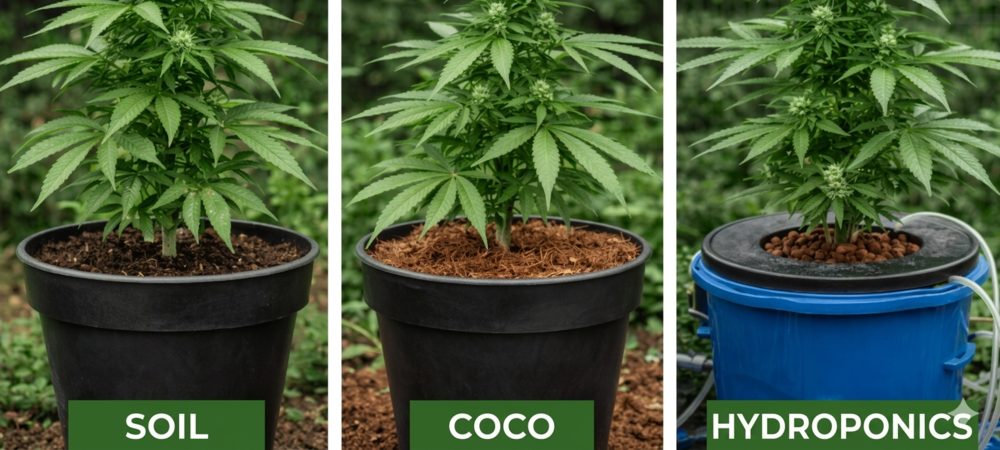
In soil, the medium has more buffering capacity. This means that, in general, small imbalances are not noticed as quickly as in other systems, although that does not mean you can improvise. Microbial activity, what the substrate already accumulates, and the speed with which the root explores the medium also play a role here.
In coco, nutrition is much more dependent on what you add to the watering, which is why it makes sense for a specific version to exist. Furthermore, in this medium, corrections are noticed sooner: if you adjust the dosage well, the crop’s response is usually seen faster; if you get it wrong, it is also noticed faster.
In hydroponics, everything is usually even more direct and fast, both successes and errors. Here, it is not enough to know how much to add, but also which format fits best with the system and the precision required by the nutrient solution.
How to use Big Bud outdoors?
Using Big Bud outdoors is not just about copying the indoor guideline. Although the base is the same, other factors come into play outdoors that change how it is applied. Flowering does not start all at once, watering does not always follow the same rhythm, it may rain after fertilizing, and the end of summer does not behave the same as the end of autumn.
Therefore, if you are looking for how to use Big Bud outdoors, it is not enough to know how many ml/L to add. The important thing is to identify well when flowering begins, understand how often it should be applied, and know how to adapt its use according to the climate.
When to start Big Bud outdoors?
Outdoors, the most common mistake is starting too early. Many people are guided by the calendar, but the most important thing is not the date, but the actual state of the plant. Big Bud makes sense when the plant has already entered flowering. It is reasonable to wait for clear signs such as:
- Appearance of visible pre-flowers at several nodes.
- Start of more stable floral formation.
- Reduction of purely vegetative stretching.
- Entry into a clearer rhythm of flowering than growth.
It is also worth differentiating between photoperiod-dependent plants and autoflowering plants. In autos, everything goes faster and the margins for error are smaller. In outdoor photoperiod-dependent plants, the change towards flowering is usually more progressive and gives you more signs to decide.
How to identify the start of flowering by hours of light?
Indoors, everything is easier to control because flowering begins when you change the photoperiod; outdoors, it does not happen that way. Here, the plant enters flowering as the hours of light begin to decrease.
On a practical level, the useful reading is this: if you still see very vegetative growth and almost no pre-flowers, it is too early. If pre-flowers are already appearing and the plant begins to concentrate energy on floral points, it is time to prepare Big Bud. If the buds are already clearly formed and starting to ask for the final fattening phase, you are probably too late to start.
How often should Big Bud be applied outdoors?
Outdoors, you don’t always water the same way. Therefore, the best way to translate it is not to think so much in “every x days,” but in which nutrient waterings you include it.
If you grow in a pot and are already in a stable fertilization routine, it can fit into the nutrient waterings of that phase. If you grow in soil and water fewer times but with more volume, it is advisable to maintain the dosage/L and not compensate by adding more product. And if you are coming from an already loaded fertilization plan, it is more prudent not to add it to every watering without first looking at how the plant responds.
What to do if it rains after applying Big Bud?
If you have applied Big Bud in the watering to the substrate and the rain arrives afterwards, it does not mean that you have automatically lost the entire application. Everything depends on where the fertilizer was when the rain arrived. If the pot or the soil had already absorbed part of the watering, subsequent rain does not simply erase what has already entered the root zone.

What you should do is assess three scenarios:
- Light rain after watering: Usually, there is no need to repeat the dosage. The most sensible thing is to wait and follow the plan.
- Heavy rain shortly after watering in a pot: Here there may be more runoff, especially if the drainage was very high and the substrate became saturated. Even so, it is not advisable to repeat the full dosage that same day. It is prudent to let the substrate stabilize and resume the guideline in the next useful watering.
- Continuous rain for several days: In this case, rather than insisting on the fertilizer, it is time to prioritize the state of the substrate. If the root is experiencing excess moisture, adding more nutrition usually does not help.
Differences between summer and autumn when using Big Bud outdoors
The dosage/L does not officially change between summer and autumn; what does change outdoors is the context of use. In summer, the plant usually has more activity, more evaporation, and more water consumption. Here, the typical mistake is to think that because it drinks more, you also have to increase the dosage. You don’t need to. The normal thing is to maintain the concentration and adjust only the watering frequency according to the actual need.
In autumn, the substrate takes longer to dry, humidity rises, and many plants reduce their rhythm. In that scenario, it makes no sense to force nutrition as if it were still summer. The best adaptation is usually not to increase the dosage, but to better adjust the application frequency.
Big Bud + Overdrive sequence in flowering
Understanding how Big Bud and Overdrive are used within the same flowering period is not just about adding both products. The key is to know when one ends and when the other begins, because each one responds to a very specific phase of the crop.
What does Overdrive do and when does it enter the crop?
Overdrive is used in the final flowering phase, when the plant has already formed the bud structure and enters the maturation and final fattening stretch. Here, the goal is no longer to build, but to optimize the final phase before harvest.
Therefore, its use usually begins in week 6 of flowering and is maintained during the last weeks of the crop. Overdrive does not replace Big Bud from the beginning, but enters when the latter ceases to make sense within the nutrition.
Why should Big Bud and Overdrive not be overlapped?
One of the most common mistakes is thinking that using both at the same time can boost the result, but in reality, the exact opposite happens. If they are overlapped, you can overload the nutrient solution, break the balance of the flowering chart, and lose the focus of each phase.
The correct logic is not to accumulate products, but to respect the transition between them. First, you work on the development phase with Big Bud, and then you move on to the final phase with Overdrive. It makes no sense to use both in parallel because they are not designed to fulfill the same function at the same time.
Big Bud + Overdrive week-by-week transition table
| Flowering Week | Big Bud | Overdrive |
|---|---|---|
| Week 1 | Do not use | Do not use |
| Week 2 | 2 ml/L (or 0.5 g/L Powder) | Do not use |
| Week 3 | 2 ml/L (or 0.5 g/L Powder) | Do not use |
| Week 4 | 2 ml/L (or 0.5 g/L Powder) | Do not use |
| Week 5 | 2 ml/L (or 0.5 g/L Powder) | Do not use |
| Week 6 | Stop using | 2 ml/L |
| Week 7 | Do not use | 2 ml/L |
| Week 8 | Do not use | 2 ml/L (depending on variety) |
Common mistakes when using Big Bud
One of the most common mistakes is starting too early, applying it when the plant has not yet clearly entered the floral formation phase. This happens a lot due to wanting to get ahead or interpreting the transition as if it were already full flowering.
Another quite common failure appears with Big Bud Powder, and it has to do with measuring the dosage incorrectly. When working with grams and not milliliters, there is less room to improvise. A small deviation can significantly alter the mixture, so it is advisable to prepare the solution with precision and not round up.
It is also very common to repeat the mistake of adding several PKs, stimulators, or additives with similar functions without checking the total load of the chart. In many cases, over-fertilization does not come from Big Bud alone, but from adding it on top of an already quite loaded routine, without adjusting the rest of the flowering plan. The correct logic is not to accumulate products, but to integrate them with purpose.
When working within the Advanced Nutrients sequence, another of the most typical mistakes is overlapping Big Bud and Overdrive, thinking that this can get more yield from the flowering. In practice, the opposite usually happens: the logic of phases is broken, the nutrient solution is overloaded, and the specific function that each product fulfills within the crop is lost.
Outdoors, it is also quite common to repeat the application after rain or not adapt the frequency well to the climate. Often, there is no need to fertilize again immediately, because part of the watering has already been absorbed. Similarly, it is not advisable to maintain exactly the same guideline in mid-summer as in autumn, since the drying rate of the substrate and the plant’s demand change quite a bit.



 Add as preferred source in Google