Personalized Attention +44 151 947 0713
 SHIPPING TO ALL

 9/10 Rating
 SALE TO MINORS PROHIBITED

The Amanita muscaria, better known as the fly agaric, is a very picturesque hallucinogenic mushroom, and its appearance is like the typical mushroom represented in our society in Super Mario games, in our mobile phone emojis, or in Alice in Wonderland.
Amanita muscaria also receives that name because during the Middle Ages it was used as an insecticide. They would cut the Amanita muscaria into slices and place them in sweetened milk to attract flies and kill them.
What is an Amanita muscaria?
The Amanita muscaria, also known as the fly mushroom, is a mushroom belonging to the Amanita genus.
Amanita muscaria mushrooms are famous for their striking, highly caricaturable appearance and their psychoactive effects. It is not considered a safe recreational drug, as some of the psychoactive compounds it contains do not work like psilocybin. Its effect is more unpredictable and can cause poisoning.
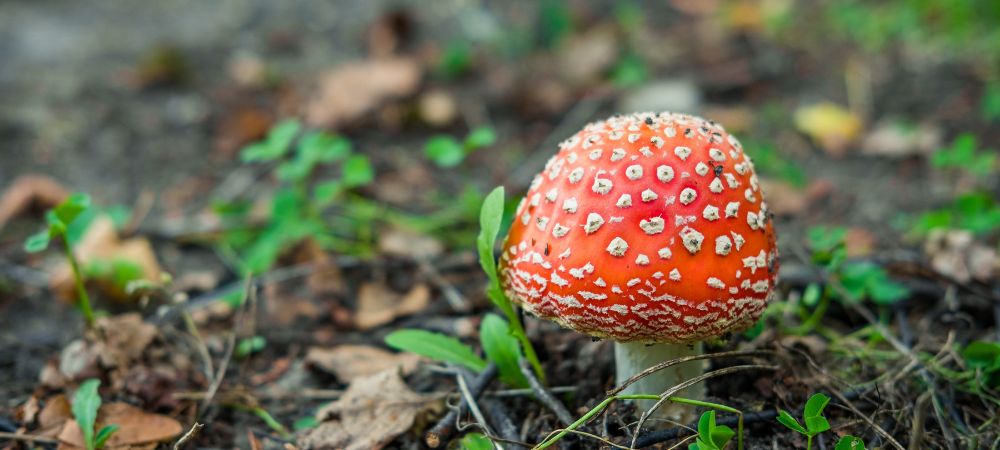
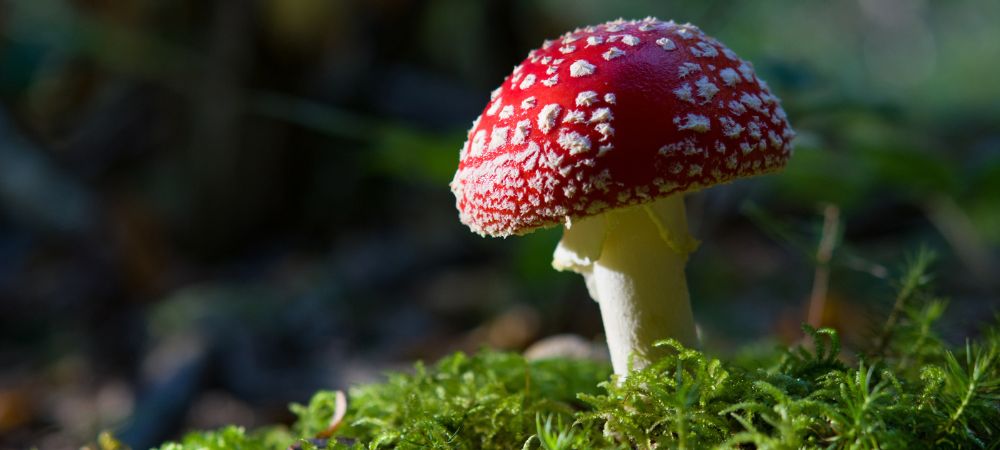
It is one of the best-known and most easily recognizable fungi, as they are red mushrooms with white spots, which give it a distinctive look.
Main characteristics of Amanita muscaria
The Amanita muscaria can be easily distinguished by observing the following characteristics:
- Cap: red to orange in color, with white spots on the surface. The Amanita muscaria can have a diameter of between 8 to 20 cm.
- Stem: white and robust, with a white ring at the top and a volva (a “skirt-like” structure at the base of the stem).
- Spores: the spores of the Amanita muscaria are white.
Where can the Amanita muscaria be found?
The Amanita muscaria mushroom grows mainly in the northern hemisphere, that is, in continental Europe and especially in Northern Europe. However, the presence of Amanita muscaria has also been detected in Brazil, South Africa, Central Asia, and North America. In short, it is present all over the planet.
Among its preferences are acidic soils at low and high altitudes, as well as the summer and autumn seasons.
The most favorable places to find the Amanita muscaria are coniferous forests (pines, firs…), beech or birch forests, at the base of the trees because it is a mycorrhizal variety.
Description of the Amanita muscaria
This species lives in symbiosis with trees: in the case of mushrooms, this union between two living beings is called mycorrhiza, in which both benefit. The Amanita muscaria provides nutrients and water to the tree (nitrogen, phosphorus…) and the tree provides fructose to the mushroom.
As we mentioned above, regarding its appearance, it fits the prototype of a mushroom with a white stem and a red cap with protruding white spots. Its diameter usually measures between 10 and 20 cm and its height from 20 to 30 cm.
Effects of the fly agaric
Initially, the effects are energizing and stimulating, later giving way to a sensation of relaxation and ending with hallucinations.
There are several myths about this mushroom, such as that it is deadly, but that is not true. In case of ingestion, the risks of dying are minimal; you will surely regret it due to the gastroenteritis it causes. But be careful, because if you exceed the doses, you can end up in a coma.
The Amanita muscaria can cause pantherine syndrome, associated with this type of mushroom. It appears between 30 minutes and 2 hours after consuming it raw. The symptoms are sedative and depressant effects, nausea, vomiting, and in some cases convulsions, all this combined with hallucinations—an explosive cocktail!
The culprits are the liquids present in the mushroom, and surprisingly, they are not psilocin or psilocybin. In this case, they are toxic elements called ibotenic acid, muscimol, muscarine, mescaline, and other alkaloids, present in different amounts depending on where they have grown.
However, there are many varieties of hallucinogenic mushrooms with psilocybin that can be found in nature, which also have different effects. The same applies to our mushroom grow kits from our Smartshop.
Traditional uses of the Amanita muscaria
Despite the side effects, which are quite unpleasant, they have always been used, and in fact are still used, in shamanic rites, often extreme ones. Clear examples are the ceremonies held in India, Iran, and Siberia. On the other hand, Hindus used them to pray to the god Soma, and they were also protagonists in Meridian, Papuan, and Celtic rites.
The only way to avoid those unwanted effects is not to ingest the mushroom raw; it is better to cook or dry it first and not eat the stem. Another alternative is to prepare infusions, oils, or smoke it. We would like to emphasize that it is important not to consume mushrooms that have not been picked by professionals, as many varieties look alike and many are deadly.
Is the Amanita muscaria edible?
It must be clear that the Amanita muscaria is not edible in its raw form, due to its toxicity. It contains compounds such as ibotenic acid and muscarine, which can cause toxic and hallucinogenic effects if consumed without proper preparation.
Ibotenic acid and muscimol have psychedelic and sedative properties, while muscarine tends to generate more physical effects by stimulating the parasympathetic nervous system.
What is muscarine?
Muscarine is a chemical substance found in several fungi, particularly in the Amanita muscaria (fly agaric). It is a toxic and psychoactive alkaloid that belongs to a group of compounds known as anticholinergics. Its name comes from the fungus Amanita muscaria, as it was first isolated from this mushroom. Characteristics and effects:
- Action on the nervous system: muscarine acts on the muscarinic receptors of the parasympathetic nervous system. These receptors are responsible for several automatic functions in the body, such as the regulation of heart rate, blood pressure, and glandular secretions.
- By activating these receptors, muscarine can cause effects such as increased salivation, excessive sweating, dilation of the pupils, decreased heart rate, and low blood pressure.
- Toxicity: if ingested in large quantities, muscarine can be dangerous. Symptoms of muscarine poisoning include nausea, vomiting, diarrhea, excessive sweating, difficulty breathing, and even death in extreme cases, although the toxicity of muscarine in the Amanita muscaria is rarely fatal on its own.
Types of Amanitas
The Amanita genus includes a large number of species, many of which are highly toxic. Some are lethal, while others can be edible or have medicinal properties. Therefore, it is important to know the differences between Amanitas to avoid potential problems:
Amanita phalloides (death cap)
The Amanita phalloides is known as the most poisonous mushroom in the world, as it is highly toxic. Because it contains amatoxin toxins that can cause severe liver and kidney damage, this type of Amanita can be fatal if consumed.
One must be careful because although it has a similar appearance to some edible mushrooms (such as Agaricus bisporus or the common mushroom), its ingestion can be deadly.
Amanita virosa (destroying angel)
Also known as the destroying angel, it is very similar in appearance to the Amanita phalloides, but white in color, and also contains amatoxins. Its ingestion is lethal.
Amanita pantherina (panther cap)
The Amanita pantherina is similar in appearance to the Amanita muscaria, but with browner tones. It contains muscimol and ibotenic acid substances, just like the Amanita muscaria. Although it has been used in ritual practices, it can cause poisoning.
Are there edible Amanitas?
Although most are poisonous Amanitas, the truth is that there are some edible Amanitas:
- Amanita caesarea (Caesar’s mushroom): it is one of the few species of Amanita that is considered edible and delicious. It has a bright orange cap and is highly prized in gastronomy, especially in Mediterranean cuisine. It is distinguished by its lack of amatoxin toxins, unlike other dangerous Amanitas.
- Amanita jacksonii (Jackson’s slender caesar): it is found in some regions of North America. Although it is rarer than the Amanita caesarea, it is also considered edible.
It is important to know all these Amanita species to be able to distinguish them and avoid ingesting a poisonous mushroom by mistake. Remember that, in matters of fungi and mushrooms, a confusion can have dire consequences.
Myths and legends
The fly agaric has given rise to several myths in stories, becoming the home of fairies or gnomes. In fact, there is a legend that even attributes to it the origin of part of the current Christmas folklore. It is even said that Santa Claus’s colors are due to the red and white of the Amanita muscaria. That reindeer eat those mushrooms and that the flying sleigh would be a hallucination, etc. Anyway, we prefer to let you draw your own conclusions about it.



 Add as preferred source in Google