Personalized Attention +44 151 947 0713
 SHIPPING TO ALL

 9/10 Rating
 SALE TO MINORS PROHIBITED

As everyone knows, cannabis plants contain what are known as cannabinoids, and they are the only plants in which these compounds can be found. Although the most well-known are THC and CBD, there are others such as CBG, THCV, CBN, HHC… In this case, the cannabinoid to be analyzed is Cannabichromene, or CBC, a compound whose first “appearance” dates back to 1966, when it was identified by Gaoni and Mechoulam, the latter also being the discoverer of the world’s most famous cannabinoid, THC. At the same time, another researcher named Claussen also identified it.
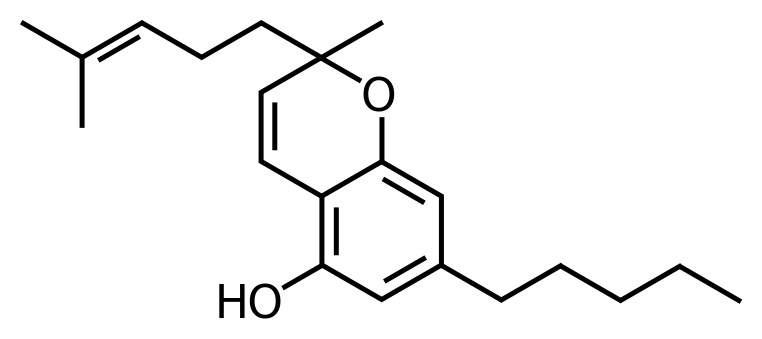
Chemical structure of cannabichromene (CBC)
This cannabinoid originates from cannabigerolic acid (CBGa) when it breaks down during the process known as decarboxylation. This simply involves the application of heat, either naturally or artificially. Interestingly, it shares the same molecular structure as other cannabinoids such as THC and CBD: 21 carbon atoms, 30 hydrogen atoms, and 2 oxygen atoms, with the molecular formula C21H30O2.
Cannabichromene is mainly found in cannabis plants during their early growth stages. As the plant matures, its Cannabichromene content decreases. Therefore, to obtain relatively higher amounts, the plant should undergo only a light maturation process.
Like other cannabinoids, it is usually present at no more than 1% once the buds have been properly dried and cured. To date, CBC is not considered a prohibited substance, as it does not appear on the list of the 1961 United Nations Single Convention on Narcotic Drugs.
However, since it shares a molecular structure with THC, some countries could potentially rely on this similarity to introduce regulations against the consumption, sale, cultivation, or study of Cannabichromene. This cannabinoid has a boiling point of approximately 220 degrees Celsius.
Medicinal properties of cannabichromene
As with most cannabinoids, research into Cannabichromene has been somewhat limited, and much remains unknown. The available studies and theories suggest that it may have antiviral, analgesic, anti-inflammatory, antidepressant, and neuroprotective properties, among others. It has also been suggested that it could act as an antinociceptive agent by altering the sensory perception of pain intensity and helping to reduce it.
Various studies indicate that Cannabichromene could be an alternative to current acne medications, potentially helping sufferers avoid the side effects associated with conventional treatments. In 2011, the Endocannabinoid Research Group, after analyzing CBC and CBD, suggested that they could help combat different types of pain, based on studies conducted on rodents.
What is cannabichromene and what effects does it produce?
As mentioned earlier, Cannabichromene on its own may offer certain effects that could be beneficial to health. However, as is often the case with these compounds, definitive conclusions will only be possible once comprehensive human clinical trials are conducted to determine its true effects.
There is hope that Cannabichromene may become a key component of medical cannabis and play an important role in the future of medicine.
At present, some companies are already marketing products rich in Cannabichromene, based on preliminary studies that do not yet conclusively guarantee the full range of claimed benefits.

Strains rich in cannabichromene (CBC)
In the cannabis world, you can find strains rich in well-known cannabinoids like THC, or others with small percentages of CBD. To find strains containing notable levels of Cannabichromene, it is best to look for landrace varieties. According to studies conducted from the 1970s onward, selective breeding and hybridization have significantly reduced CBC levels. Originally, Cannabichromene was the second most abundant cannabinoid in some of the plants analyzed.
Varieties that have undergone few changes
To find strains with higher Cannabichromene content, it is advisable to seek out tropical-origin genetics or native varieties that have undergone minimal crossbreeding. Some have been crossed very little over the years, or only with plants of the same lineage. These include:
Acapulco Gold (Sativa)
Acapulco Gold delivers a powerful effect that promotes positive thoughts and provides full-body relaxation.
Indoors, it can grow up to 1.5 meters tall and yield around 550 grams per square meter. Outdoors, it can reach 2 meters and produce approximately 600 grams per plant.
Hindu Kush (Indica)
This strain produces a strong, long-lasting effect that is both relaxing and therapeutic.
Indoors, it grows to about 1 meter in height and yields around 400 grams per square meter. Outdoors, it can reach 2 meters and produce up to 400 grams per plant.
Durban Poison (Sativa)
Originating from the African continent, this strain is known for its strong psychoactive potency and energizing effects.
Indoors, it can grow up to 1.5 meters tall and yield around 550 grams per square meter. Outdoors, it may reach up to 3 meters and produce as much as 600 grams per plant.
Cannabichromene is one of those lesser-known cannabinoids that is nevertheless gaining increasing interest in both scientific and therapeutic fields. Although it has historically remained in the shadow of THC and CBD, its potential as an analgesic, anti-inflammatory, neuroprotective agent, and even as an alternative in dermatological treatments makes it a compound worthy of further research.
At present, the available scientific evidence remains limited, often coming from preliminary or animal-based studies. For this reason, it is essential to approach commercial products claiming benefits from Cannabichromene with caution until more conclusive human research is available.
The future of Cannabichromene will largely depend on advances in scientific research and the legal frameworks that allow for deeper study. What is clear is that the cannabis universe extends far beyond THC and CBD, and cannabinoids like Cannabichromene could play a significant role in the medicine of tomorrow.