Personalized Attention +44 151 947 0713
 SHIPPING TO ALL

 9/10 Rating
 SALE TO MINORS PROHIBITED

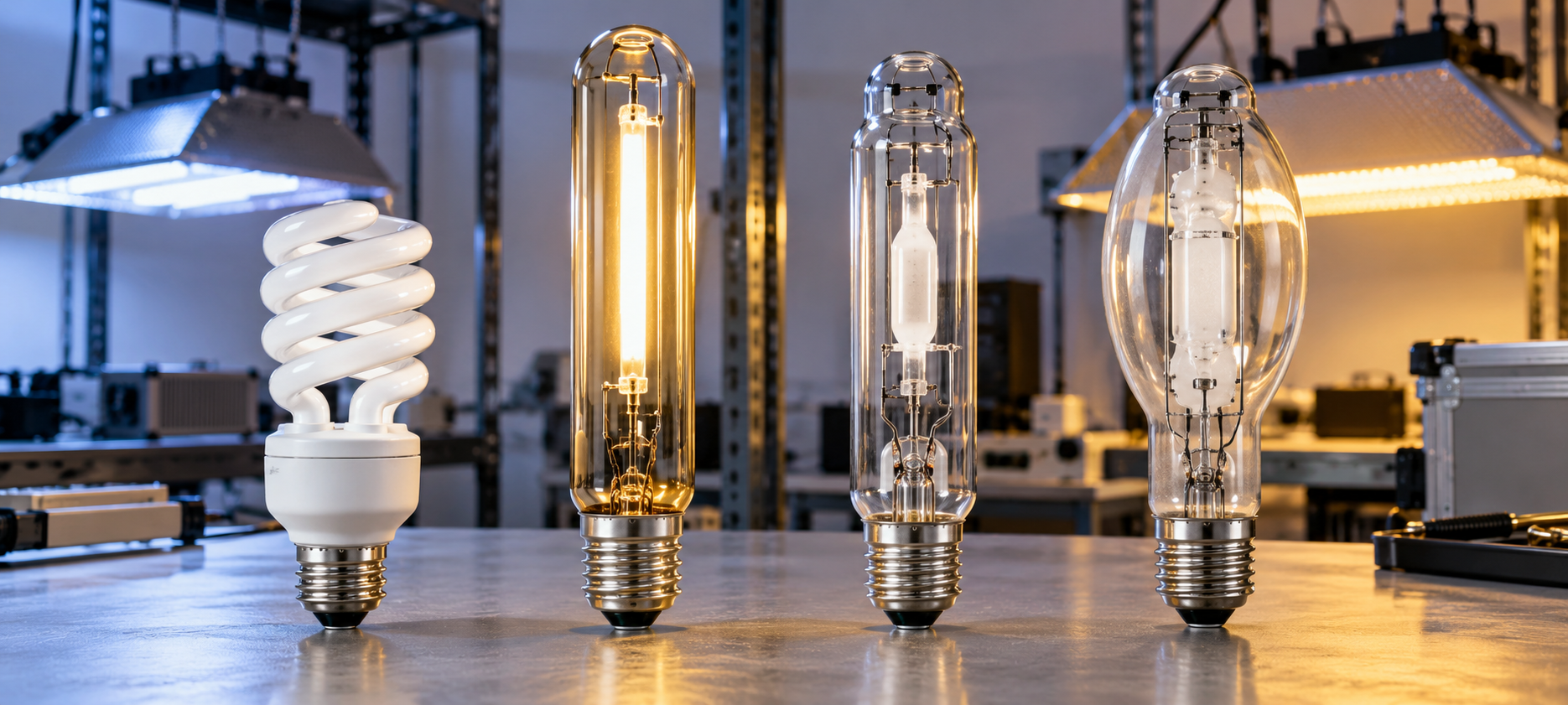
There are different types of light bulbs for indoor marijuana cultivation, each with specific characteristics, spectrum, and power. When you don’t know which bulb to use or why one model costs more than another, knowing these differences will help you choose the right lighting.
Traditionally, types of indoor cultivation bulbs have been divided into two large families: low-consumption lamps and discharge lamps. One of their main differences is that discharge lamps require a ballast, while low-consumption ones incorporate the necessary equipment to connect directly to the mains via a compatible lamp holder.
Within these families, we also find growth, flowering, and mixed-spectrum bulbs. Growth bulbs provide a whiter or bluish light, while flowering bulbs offer more yellowish and reddish tones.
Mixed bulbs are used for both growth and flowering. They are a common choice among those who want to complete the entire cycle without changing the lamp.
Currently, within the types of indoor cultivation bulbs, there are also technologies such as LED and LEC, which have considerably expanded lighting possibilities. The European Commission distinguishes, among others, LED, HID, and CFL light sources according to their technology and efficiency. However, in this article, we will focus mainly on traditional CFL, HPS, and MH bulbs.
Power should be chosen according to the available space, ventilation, distance from the plants, and the type of reflector used. Below, we explain the main options so you can better orient yourself.
Low-consumption bulbs:
These are large CFL lamps with a shape similar to household low-consumption bulbs. They are especially useful when working in small spaces, as they generate less heat than discharge lamps and make temperature control easier.
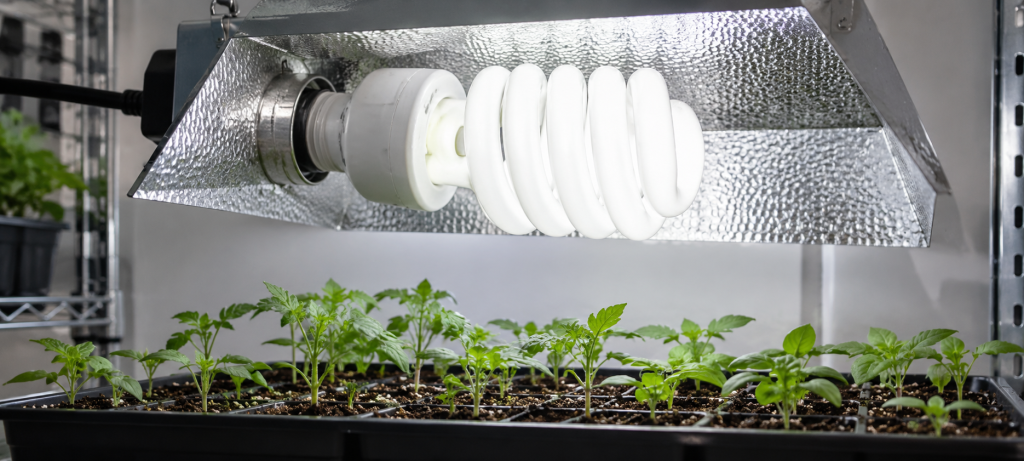
They consume less electricity than a high-power HPS and are easy to install. They only need a compatible reflector with a socket and a mains connection.
CFL growth bulbs can be used to light small propagators, maintain mother plants, accompany seed germination, or complete the first stages of growth. They can also serve as supplementary lighting when excess heat prevents the use of multiple HPS lamps.
Flowering CFLs have a more yellowish tone. However, their intensity is usually lower than that of other systems, so they work better in small spaces or as support for another light source.
They are available in different wattages. The surface area each can cover will depend on the reflector, placement height, and space conditions, so it is advisable to consult the manufacturer’s specific instructions.
You can check the available models in our low-consumption lamps category.
Discharge bulbs:
Discharge bulbs produce light using different gases and compounds inside. The most common are high-pressure sodium (HPS) and metal halide (MH) bulbs.
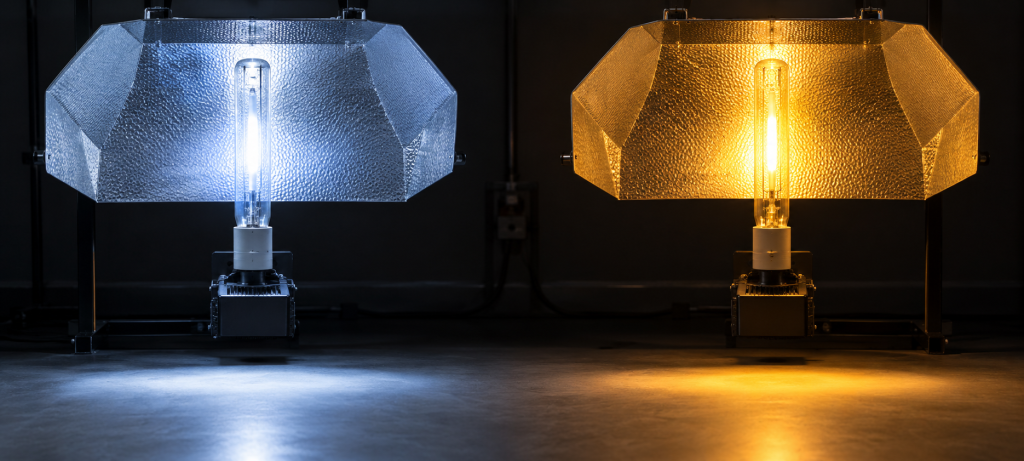
All of them require a compatible ballast that regulates the current and allows the bulb to be turned on safely. The ballast power must match the lamp’s power, unless a compatible dimmable electronic unit is used.
As a general guide:
- A 250 W bulb can be used in spaces of approximately 60 × 60 cm or 80 × 80 cm.
- A 400 W bulb can cover approximately between 80 × 80 cm and 100 × 100 cm.
- A 600 W bulb is usually used in spaces between 100 × 100 cm and 120 × 120 cm.
- 1000 W bulbs are intended for large installations with adequate ventilation and height.
These measurements are approximate and may vary depending on the reflector, crop distribution, and the ability to control temperature.
Mixed bulbs for growth and flowering
Agrolite Gro & Flo bulb
The Agrolite SHP Mixed Gro & Flo bulb is one of the most used options due to its price. It offers a spectrum valid for both growth and flowering, allowing you to complete the entire cycle without changing the bulb.
With use, HPS bulbs lose light intensity even if they still turn on. Therefore, it is advisable to check their performance and replace them periodically to avoid a loss of efficiency.
It is currently available in 250, 400, and 600 W wattages.
Sylvania Grolux bulb
The Sylvania Grolux bulb is a mixed-spectrum HPS lamp that can be used during growth and flowering.
Its light has a yellow tone, closer to the spectrum used during flowering. In growth, it can produce plants that are somewhat more stretched than a specific metal halide bulb, but it avoids having to change the lamp when modifying the photoperiod.
It is currently available in 600 W.
Philips Green Power bulb:
The Philips Green Power bulb is a mixed bulb that can be used throughout the cultivation cycle.
It offers a yellow and orange-toned light, especially appropriate for flowering, although its spectrum also allows plants to be maintained during growth. It is an interesting option when looking for good performance without having to change bulbs between phases, which is especially convenient when using a Cooltube Glass reflector.
It is currently available in 400 and 600 W wattages.
Growth bulbs
Philips HPI-T bulb:
The Philips HPI-T bulb is a metal halide lamp intended mainly for the growth phase.
Its white and bluish light favors more compact development, with stems and branches prepared to subsequently support flowering. It can also be useful for maintaining a mother plant and encouraging the appearance of new shoots without the tips stretching too much.
It is a powerful bulb that generates quite a bit of heat, so it must be kept at a safe distance and used with adequate ventilation. The thermo-hygrometer should be placed at the height of the tips to verify that the temperature remains within the appropriate values.
Currently, the variant available in the catalog is the 1000 W one, intended for large and properly conditioned installations.
Which power and type of bulb to choose?
The choice will depend mainly on the surface area, the cultivation phase, and the ability to control the temperature.
Low-consumption bulbs are appropriate for propagation, mother plants, early growth, and small spaces. MH bulbs provide a spectrum more suitable for growth, while HPS bulbs are used mainly during flowering.
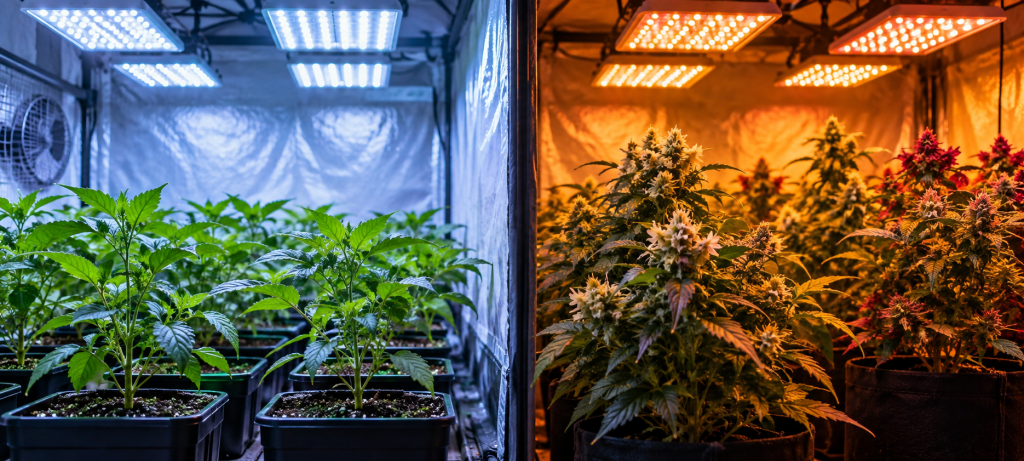
Mixed bulbs allow you to complete the entire cycle with a single lamp, although a specific bulb for each phase can offer a spectrum more adjusted to the plants’ needs.
It should also be taken into account that current LED systems generate less heat, offer high efficiency, and do not need an external ballast. Therefore, before choosing, it is advisable to compare all available technologies according to the space conditions.
You can check all available models in our indoor cultivation bulbs section.