 Personalized Attention +44 151 947 0713
 SHIPPING TO ALL


 9/10 Rating
 SALE TO MINORS PROHIBITED


Have you ever stopped to think about how marijuana affects you? We all know that smoking a good joint or eating a space cake usually causes the well-known munchies, uncontrollable laughter, a bit of sleepiness, and a multitude of effects that are usually quite pleasant.
If you are a regular user and have tried germinating various marijuana seeds, you will be well aware of the side effects of marijuana, but did you know that there are effects that are not visible to the naked eye?
The side effects of marijuana
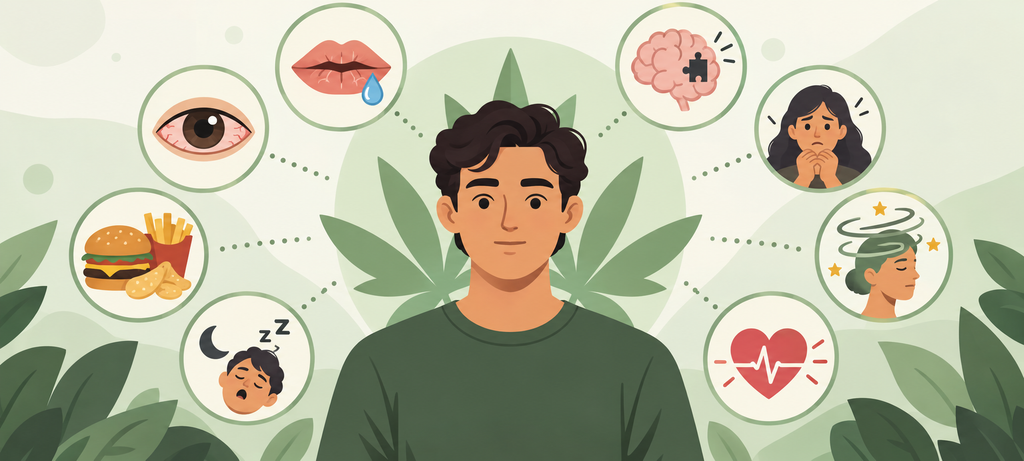
When we talk about side effects of marijuana, we usually think directly of dry mouth, red eyes, hunger, or drowsiness.
Apart from these typical side effects that we already know, there are also a series of side effects that deserve to be mentioned.

Lung Capacity
It is said that one of the lesser-known side effects of smoking marijuana is that it helps in a certain way to increase lung capacity.
It is a quite curious fact and still under study. This comes from a well-known study that followed more than 5,000 people for approximately 20 years and found a curious result: among those who had low or moderate exposure to cannabis, some lung function parameters did not decrease in the same way as they did among tobacco smokers.
Even slightly higher values were observed in certain lung measurements among some occasional users.
However, this does not mean that smoking marijuana strengthens the lungs nor that the smoke is beneficial. Combustion still generates irritants, and smoking cannabis can cause coughing, mucus production, and other respiratory problems.
Although smoking cannabis involves combustion and exposure to irritants, vaping cannabis avoids that combustion, which is why it is proposed as a different alternative among consumption methods.
The interesting thing about these results is that they show that the relationship between cannabis and lung function is not exactly the same as that observed with tobacco, although there are still many factors to study.
Appetite and Body Weight
One of the most famous effects of cannabis is the munchies: that sudden increase in appetite that can make anything in the fridge seem especially appetizing.
That is why it is curious that different studies have observed that some cannabis users have, on average, a lower body weight or a lower BMI than people who do not use it.
A review that grouped different investigations also found reductions in certain body measurements among some users.
Does this mean that marijuana makes you lose weight? No.
The relationship between cannabis, metabolism, diet, and body weight is much more complicated. Lifestyle, diet, frequency of use, and a multitude of personal factors also play a role.
What we do know is that cannabis can increase appetite in the short term, while some population studies have found apparently contradictory results regarding body weight. Precisely that paradox is what makes this line of research especially interesting.

Sleep Onset
Another of the most well-known effects of cannabis is the sensation of relaxation or drowsiness that some people experience after consuming it. For this reason, many users associate certain varieties or products with falling asleep more easily.
However, the effect of cannabis on sleep is not as simple as saying that it always helps you sleep better. For years, THC has been especially linked to changes in the different phases of sleep, including the REM phase, which is when the most intense dreams usually occur.
In fact, it is also said that when consuming marijuana before sleeping, in many cases you do not reach the REM phase. For some, this can be quite beneficial because they suffer every night from nightmares related to anxiety or post-traumatic stress. The ability to eliminate the REM phase, and therefore eliminate dreams, can even change the lives of those patients who suffer from chronic nightmares.
Older studies observed a reduction in REM sleep under certain conditions. However, more recent research shows much more varied results: the effect can change depending on the dose, the composition of the cannabis, the frequency of use, and the characteristics of each person.
What is quite curious is the so-called REM rebound.
Some regular users say that when they stop consuming for a few days, they begin to have much more intense or easier-to-remember dreams. This phenomenon has also been observed in studies on cannabis withdrawal.
So that saying “when I stop smoking I dream much more” is not exactly an unknown sensation.
Other side effects of marijuana
Beyond these curiosities, there are other side effects of cannabis that are much easier to recognize.
Among the most common are:
- Dry mouth.
- Red eyes.
- Increased appetite.
- Drowsiness or a feeling of relaxation.
- Temporary impairments in memory and attention.
- Changes in time perception.
- Reduced coordination and reaction time.
- Temporary increase in heart rate.
- Anxiety or paranoia in certain people.
The intensity of these effects can vary greatly.
The same amount can be relaxing for one person and too intense for another. Factors such as THC concentration, the user’s previous experience, or even the environment can considerably change the experience.
Cannabis can temporarily affect memory, attention, coordination, and reaction time, which is especially important before performing activities that require concentration.
It can also cause anxiety or unpleasant thoughts in certain people, especially when consuming high amounts or products with a high THC concentration.
The side effects of marijuana are much more varied than they might seem at first glance.
Some are perfectly well-known, such as the munchies, relaxation, red eyes, or dry mouth. Others, such as its relationship with sleep, body weight, or certain lung function measurements, have been sparking the interest of researchers for years.
The most important thing is to remember that cannabis does not affect everyone the same way.
The amount consumed, THC concentration, tolerance, frequency of use, and personal characteristics can make the experience change considerably from one person to another.
There are still many aspects of cannabis to understand, and precisely for that reason, it continues to be an especially interesting plant from a research perspective.



 Add as preferred source in Google


