Personalized Attention +44 151 947 0713
 SHIPPING TO ALL


 9/10 Rating
 SALE TO MINORS PROHIBITED


In this article, we will talk about one of the most important parts of a marijuana plant: the root. The plant’s health and the possibility of obtaining quality or mediocre harvests depend on it. We will raise awareness about the importance of having a healthy root system and how to achieve it.
If we think quickly, what is a root? The first thing that comes to mind is that it is the part through which plants and trees feed. And this is correct; basically, it is the part with which they capture the nutrients found around them, although it also serves as an anchor in the soil where they were born. But do we really know how it develops, what its parts are, and what each of them does? Now you will be able to know for sure and be able to achieve a championship-worthy root system.
Parts of a root
The root system is made up of different structures. Each one is involved in the growth, absorption, or anchoring of the plant.
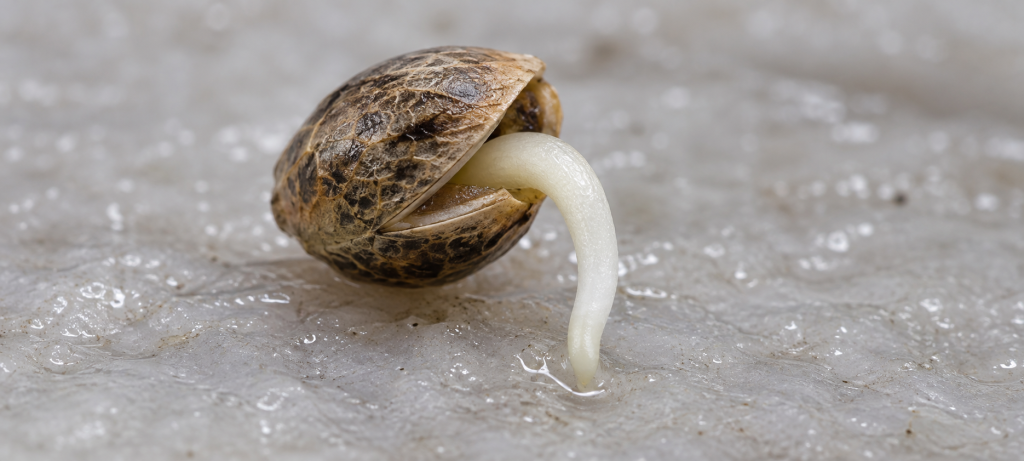
- The radicle is the first part that develops once the seed begins to germinate. It is that small white tip that appears when the seed opens for the first time. This primary root or radicle serves initially for the anchoring of the seedling in the growing medium we are working with, helping the seedling to fix itself in the soil and be able to germinate completely, breaking the surface layer of the substrate, successfully searching for and finding light. At the same time that it performs this function, it continues to develop without stopping, ceasing to be a radicle to become a primary root, starting to create root hairs and/or absorbent hairs and secondary roots.
- The second part that develops within a root system is the root hairs or absorbent hairs, whose objective is the absorption of mineral salts from the soil. These root hairs are of vital importance, as they are responsible for capturing the food around the roots and starting the transport process towards the aerial parts of the plant (trunk, branches, and leaves). It is very important that these root hairs are kept in optimal conditions.

- The third part that begins to form in the root system is the secondary roots. These develop and extend in a more lateral way if we compare them with the main root, which develops more in depth. Thanks to the secondary roots, the plant, on one hand, achieves a greater and better anchorage to the growing medium, allowing it to withstand the inclemency of strong winds. On the other hand, it manages to expand laterally, which allows it to go in search of new areas in the growing medium or soil rich in nutrients, thus obtaining food to survive and continue its development.

How the root system develops
After germination, the primary root grows in depth and begins to produce lateral branches. As the plant develops leaves and increases its photosynthesis, it can allocate more energy to root growth.
Development is not unlimited. It can be conditioned by:
- The volume of the container.
- The structure and compaction of the substrate.
- The amount of available oxygen.
- The temperature of the root zone.
- The frequency and amount of watering.
- The pH and salt concentration.
- The presence of pathogens.
- The general state of the plant.
Healthy roots usually have white or cream tones, especially in their young areas. However, the color can also vary due to the substrate, fertilizers, or certain products, so it should not be used as the only indicator.
How to care for a plant’s roots
To obtain good root system development, you must maintain a balance between water, oxygen, temperature, and nutrition.
In addition, we have to take several factors into account:
- One of them is the growing medium we are going to use. The substrate must retain enough moisture without remaining constantly waterlogged. It also needs a structure that allows air entry and root growth. It is not essential that the packaging expressly states that it is designed for cannabis. The important thing is that its characteristics are suitable for the type of crop and the stage of development.
- In soil, aeration can be improved using materials such as perlite, coconut fiber, or other structural components.
- In hydroponics, the nutrient solution must be kept properly oxygenated.
- Another important factor is water quality.
- Tap water does not have to be harmful to the roots. Its suitability depends mainly on its hardness, alkalinity, EC, and concentration of elements such as sodium or chlorides. Before discarding it, it is advisable to measure it or consult an analysis from the supplier company.
- Osmosis water can be useful when the source water contains too many salts. However, it has a very low mineral concentration and may need to be supplemented with calcium and magnesium before preparing the nutrient solution.
- Distilled water should not be considered automatically better either. Used without adjustment, it is practically devoid of minerals and has very little buffering capacity.
- The pH factor affects nutrient availability, but there is no single appropriate value for all systems.
| Indicative pH range according to growing medium | |
|---|---|
| Growing medium | Indicative pH range |
| Soil and organic substrates | 6.0-6.5 |
| Coco | 5.7-6.2 |
| Hydroponics | 5.5-6.2 |
- The EC should be the one recommended for each stage of plant development, trying to avoid excesses, since they will create a certain degree of toxicity in the growing medium, harming the health and absorption capacity of the roots.
| Indicative EC according to cultivation stage | |
|---|---|
| Stage | Indicative EC |
| Seedlings and rooted cuttings | 0.4-0.8 mS/cm |
| Growth | 0.8-1.4 mS/cm |
| Flowering | 1.2-2.0 mS/cm |
- Proper oxygenation of the roots is also vital. We need the growing medium to have a certain amount of water so that the roots can hydrate, but also oxygen. Therefore, we will try not to waterlog the substrate or non-hydroponic growing medium, to prevent the roots from drowning. A waterlogged substrate limits and reduces the amount of oxygen and prevents normal root development; it is also the ideal environment for harmful fungi.
- We must also avoid excessive dryness of the substrate or medium as a factor. This can create an irrecoverable loss of the root system, which ultimately leads to an excess of nutrients, nutritional disorder, and finally a large decrease in final production.
- Temperature influences the metabolic activity of the roots and the amount of oxygen dissolved in the water. Roots like to be in a humid environment and with a little warmth, so when we go to water, as a guide, the irrigation water can be kept around 18-22 °C, avoiding extreme temperatures. Below or above these figures, the water in question would contain a low percentage of oxygen; furthermore, water with temperatures below 15 °C slows down normal root development. A temperature above 30 °C can literally cook the roots.
Using a quality root stimulator, designed specifically for the strong and healthy development of roots, such as BAC’s Root Stimulator or Atami’s Rootbastic, will greatly facilitate the growth work for the plant, providing the necessary nutrients so that the roots grow strong and healthy quickly.
The application of beneficial bacteria and fungi such as Funky Fungi or Bactohemp will protect the rich root system created against the attack of diseases or root fungi; in addition, the plant will also benefit from their use, as it will increase the plant’s nutrient uptake capacity, increasing the overall production of plant mass.
As you have been able to verify, there are several factors that must be taken into account to keep the roots in perfect development and maintenance. At first, it may seem too complex. But as soon as we have assimilated and understood this data, we will realize that it is simpler than it seems to have excellent root system development.
Quick guide to maintaining healthy roots
- Use an aerated medium with good drainage.
- Analyze the water before deciding if you need osmosis.
- Adjust the pH according to the growing medium.
- Adapt the EC to the stage and the plant’s response.
- Keep irrigation water at a moderate temperature.
- Avoid both waterlogging and extreme dryness.
- Increase the pot size when the roots need more space.
- Avoid excessive fertilizer concentrations.
- Use stimulators and microorganisms while respecting their instructions.
- Keep irrigation tanks clean and properly oxygenated.
As long as we have this more or less controlled, everything should go smoothly with our root system.