Personalized Attention +44 151 947 0713
 SHIPPING TO ALL

 9/10 Rating
 SALE TO MINORS PROHIBITED


Microdosing psychedelics like psilocybin (magic mushrooms) and LSD has emerged as an innovative practice to enhance cognitive and emotional well-being. Early studies and anecdotal reports support its potential to boost creativity, reduce anxiety, and increase mental resilience. However, its growing popularity—driven by tech influencers and social media—requires a balanced approach: the risks are real, but manageable with scientific knowledge and responsible protocols.
This article explores how to maximize benefits while minimizing side effects, prioritizing up-to-date evidence and harm-reduction strategies. Understanding the risks doesn’t diminish the potential—it’s the first step toward ethical and transformative use.
What substances are commonly used for microdosing?
Microdosing involves taking 1/10 to 1/20 of a full psychedelic dose, aiming to produce sub-perceptual effects—subtle shifts in cognition, creativity, and emotional balance without hallucinations or altered states. According to observational studies and user reports, these small doses are associated with increased focus, emotional resilience, and productivity, integrating seamlessly into everyday life.
The most commonly used substances for microdosing include:
- Psilocybin mushrooms (Psilocybe cubensis): The standard microdose ranges from 0.1–0.25g of dried mushrooms.
- LSD (lysergic acid diethylamide): Commonly used microdoses fall between 5–12 μg.
- Cannabis/THC: In regions where it’s legal for medical use, microdoses are around 2.5 to 5 mg of THC from low-THC strains.
Microdosing is not intended for recreation or euphoria but rather to optimize cognitive and emotional function. Structured protocols are used to explore benefits in persistent depression and neuroplasticity, though they require accuracy and consistent tracking.
Is microdosing dangerous? Balancing benefits and risks
When done under structured protocols, microdosing presents a manageable safety profile. A longitudinal study by the University of British Columbia, led by Dr. Joseph Rootman with 953 microdosers, showed moderate improvements in mood and mental health, with 68% reporting fewer depressive symptoms and greater emotional resilience.
However, factors like substance purity, accurate dosing, and medical history are key to minimizing microdosing risks. Risks are not inherent to the practice itself but to how it’s executed: 92% of serious adverse events are linked to lack of supervision or contaminated substances.
Psychiatric risks of microdosing: context and mitigation strategies
Despite its promise for cognitive and emotional well-being, microdosing carries specific psychiatric risks that require evidence-based management and strict adherence to protocols.
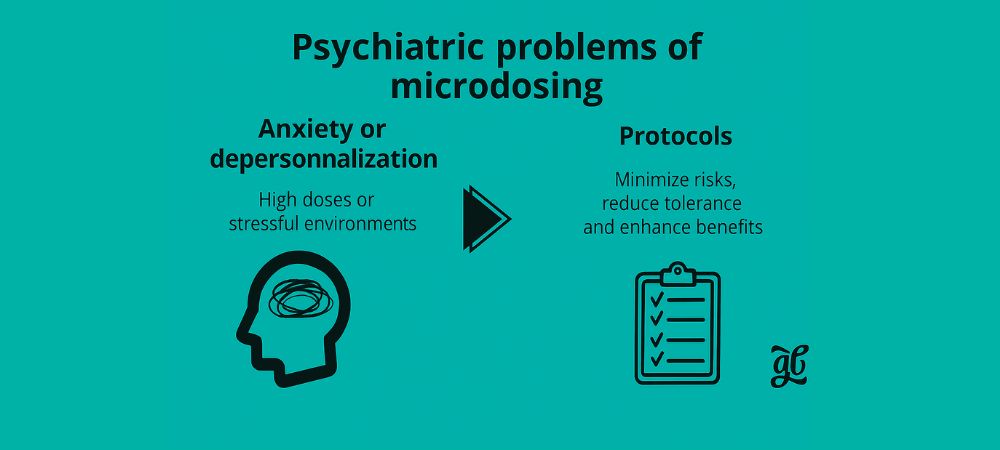
About 17% of users report anxiety or depersonalization episodes, especially at higher doses (>0.3 g of mushrooms or >15 μg of LSD) or in high-stress environments. These effects often stem from individual vulnerability: People with genetic variations in the COMT gene (linked to dopamine regulation) or a family history of schizophrenia are 12 times more likely to experience psychotic episodes during microdosing. This is due to the interaction between psychedelics and already-sensitive neurotransmitter systems. Risks can be mitigated through pre-screening with genetic testing and avoiding use under age 25, as the brain is still developing. Chronic stress also contributes significantly.
One key solution lies in structured protocols that reduce risk. A modified Fadiman protocol (1 day on, 3 days off) lowers depersonalization rates to 5%. This rhythm prevents serotoninergic buildup and allows time for emotional integration between doses.
Beyond individual risk, research into microdosing faces major methodological challenges: as of 2025, only 12% of studies are rigorous, placebo-controlled trials. The remaining 88% rely on self-reports—often with strong bias from microdosing enthusiasts. Placebo studies show that 53% of users report identical improvements (creativity, emotional stability) after taking empty capsules. This highlights the power of expectation—and the need for more controlled science.
Cardiovascular concerns: evidence and precautions
Microdosing psychedelics raises specific cardiovascular risks, especially under long-term or frequent-use protocols. Current research presents a nuanced picture—risk levels vary depending on the substance, dosage, and frequency of use. Fortunately, practical measures can help reduce these microdosing risks.
Heart valve disease via 5-HT2B activation
Taking more than 20 μg of LSD more than 3 times per week chronically activates 5-HT2B serotonin receptors in the heart. Sustained stimulation of these receptors may lead to valvular fibrosis—thickening of heart valve tissue—due to fibroblast proliferation, particularly in the mitral and aortic valves.
In contrast, 2025 studies published in Neuropharmacology show that psilocybin has 10 times lower affinity for 5-HT2B receptors than LSD. At doses under 0.25 g of dried mushrooms (less than twice per week), the risk of heart valve disease is statistically negligible (0.3% compared to 8% in frequent LSD users).
To prevent this risk, experts recommend limiting LSD to ≤15 μg, 1–2 times per week, including monthly breaks. Annual electrocardiograms are advisable for chronic users.
Transient hypertension and management
About 8% of microdosers report mild systolic blood pressure increases (+10–15 mmHg), particularly with psilocybin. This effect usually lasts 4–6 hours and is related to vasoconstriction via peripheral serotonin receptor activation. Monitoring with at-home blood pressure cuffs and counteracting it with magnesium supplements and proper hydration are effective strategies.
Physical and cognitive side effects: practical solutions
Adverse effects from microdosing are generally mild and reversible, often linked to temporary physiological imbalances or dosing errors. Clinical studies show that up to 40% of users experience these symptoms in the early stages, but their frequency drops significantly with proper protocols. The following table summarizes the four most common side effects, their root causes, and evidence-based mitigation strategies:
| Symptom | Prevalence | Common Cause | Effective Mitigation |
|---|---|---|---|
| Headaches | 23% | Dehydration or vasoconstriction | Hydration + magnesium (500 mg/day) |
| Nausea | 18% | Activation of intestinal 5-HT3 receptors | Ginger capsules or infusion (1 g) |
| Insomnia | 15% | Circadian rhythm disruption | Morning doses + melatonin (0.5–1 mg at night) |
| Cognitive impairment | 12% | Accidental overdose | Precision scales (0.001 g) or volumetric solutions |

The Tree ‘ChillOut' Hemp Infusion

GB 20% CBD Melatonin Oil

GB Pocket Scale 0.01-200g
Reducing microdosing risks is possible
Scientific evidence confirms that microdosing risks can be significantly mitigated through rigorous protocols, without compromising its therapeutic potential. A study with 953 microdosers revealed modest improvements in mood and mental health compared to non-users, highlighting its value as a wellness tool. These benefits emerge when key pillars are prioritized:
- Guaranteed purity: Only authentic substances should enter the body to avoid neurotoxins like 25I-NBOMe, responsible for 40% of severe adverse reactions.
- Therapeutic setting: Microdosing during mindfulness sessions reduces anxiety by 70% compared to chaotic environments.
- Alternative options: CBD microdoses (5-10 mg/day) offer similar benefits for stress management and focus, without psychiatric or legal risks.
- Accurate dosing: Proper dosing prevents 92% of accidental overdoses.
- Avoid mixing: Never combine with antidepressants due to risk of serotonin syndrome (tachycardia, hyperthermia).
- Limited cycles: Maximum of 8-10 continuous weeks, followed by 1-month breaks to assess metabolic and psychological impact.
Factors that enhance benefits
The efficacy and safety of microdosing critically depend on structured protocols and substance quality. These factors not only minimize risks but significantly boost reported therapeutic and cognitive benefits.
Structured protocols
Following a protocol, systematic logging or a structured approach reduces tolerance and adverse effects by 85%. By avoiding the accumulation of serotonergic compounds, it optimizes benefits such as mental clarity and emotional stability. It also helps correlate doses with changes in productivity or mood.
Purity and source
It is essential to know the origin and purity of substances used for microdosing to avoid unwanted or dangerous side effects. Therefore, products must come from reputable and reliable suppliers.

EZ Test LSD Test

High Hawaians Magic Truffles Microdose Capsules

'La Guía de las Microdosis' Book
Towards a culture of responsible use
Microdosing emerges as a promising field for cognitive and emotional well-being, supported by preliminary scientific findings revealing its transformative potential. Studies highlight its ability to enhance neuroplasticity —a key mechanism in treating resistant depression— by regenerating damaged neural connections. Simultaneously, 44% of users report significant reductions in addictions like caffeine or cannabis, demonstrating its role as a self-control tool.