Personalized Attention +44 151 947 0713
 SHIPPING TO ALL

 9/10 Rating
 SALE TO MINORS PROHIBITED

The right tools for growing cannabis are the starting point for achieving healthy, productive, and easy-to-manage plants, whether you’re growing indoors or outdoors. Choosing the right equipment not only influences the final harvest but also determines how much time, money, and trouble you’ll have during the process.
In this practical guide, we explain which tools you really need, which are essential, and which are worth adding based on your level and goals.
What are “marijuana growing tools” and why do they matter
When we talk about tools for growing marijuana, we’re not just referring to “gadgets.” It includes all the material that allows you to control the environment, watering, nutrition, plant health, and the harvesting process.
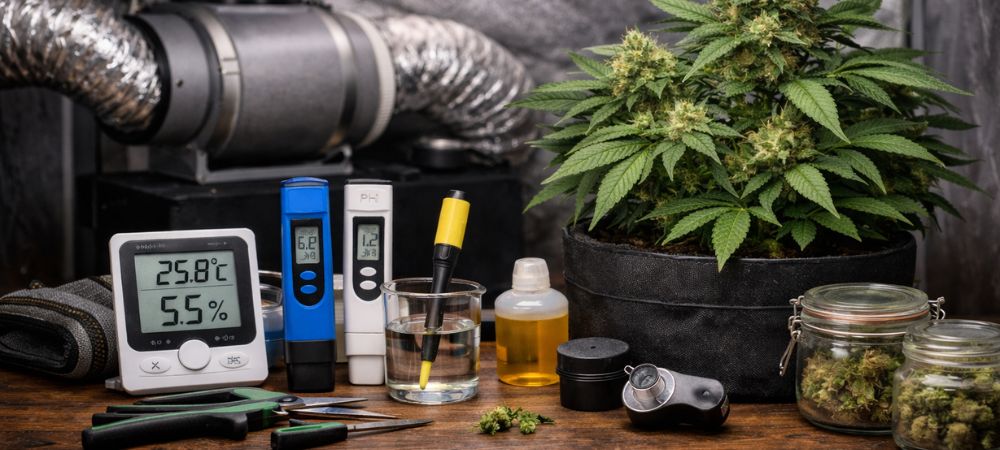
The greater the control, the less improvisation, and the more predictable the outcome. A well-equipped grow isn’t necessarily more expensive, but it is more efficient.
Indoor vs. Outdoor: Different Equipment, Same Logic
The key difference between indoor and outdoor growing isn’t the goal, but the environment.
In indoor growing, you must recreate natural conditions (light, air, temperature, humidity). In outdoor growing, nature does part of the work, and your tools focus on supporting and correcting problems. In both cases, measuring and anticipating are the basis for success.
Quick Checklist of Tools by Phase
Before going into detail, this table helps you visualize what tools you need according to the growing phase.
| Necessary Equipment by Growing Phase | |||
|---|---|---|---|
| Phase | Essential | Recommended | For Pros |
| Setup | Grow tent, light, extractor | Timer, power strip | Digital controllers |
| Vegetative | Thermo-hygrometer | pH meter | EC meter |
| Flowering | Carbon filter | Extra fans | Automation |
| Harvest | Scissors, gloves | Trichome magnifier | Microscope |
| Curing | Airtight jars | Mini hygrometers | Active control |
Essential Tools for Indoor Growing
Indoor growing generates the most searches when talking about marijuana growing tools because it requires more initial planning.
Growing Space: Tent and Organization
The grow tent is the foundation of indoor growing. It allows control over light, air, and discretion, in addition to keeping the space clean and organized.
A good grow tent makes daily work easier and prevents common problems like light leaks or poor ventilation.
Grow Lighting: How to Choose Without Mistakes
If there’s one decisive tool indoors, it’s lighting. Plants live on light, and any mistake here is paid for with slow growth or poor flowering.
Light is the engine of the grow. Nowadays, LED grow lighting is the most efficient option for most users, although HPS or CFL systems also exist. Even so, the important thing isn’t just the type of lamp, but that it’s properly sized for the space. A powerful light that’s poorly distributed is as problematic as a weak light.
| Types of Grow Lights and When to Choose Each | |||
|---|---|---|---|
| Light Type | Advantages | Disadvantages | Ideal For |
| LED | Low consumption, low heat | Initial investment | Modern indoor grows |
| HPS | Intense production | High heat | Large spaces |
| CFL | Economical | Low power | Spot support |
Ventilation and Odor Control
Air is the most overlooked aspect by beginners. A good ventilation system renews oxygen, regulates temperature, and prevents humidity buildup. A good ventilation system includes an extractor, an intake fan (or passive intake), a carbon filter, and fans.
Constant air renewal prevents mold, improves growth, and allows for odor control, which is crucial indoors.
Environmental Control: Temperature and Humidity
The thermo-hygrometer is one of the most undervalued yet most important tools for growing marijuana. Measuring temperature and humidity allows you to anticipate problems like heat stress, botrytis, or slow growth.
Not measuring these variables is like driving without looking at the dashboard: you might move forward, but you don’t know the conditions.
Watering and Water: Less is More
This is where the biggest gap often appears between beginner and advanced growers. The pH meter allows you to adjust the water so the plant can absorb nutrients correctly. The EC meter indicates the amount of salts in that water.
Not all grows require these meters from day one, but when problems arise, they are the quickest way to find the real cause.
Watering cans, measuring syringes, or small reservoirs are sufficient for most grows. The key isn’t the system, but the regularity and correct drainage.
Substrate, Pots, and Nutrition
These three elements work quietly but are necessary for a good marijuana grow. The type of substrate and pots determine how you water and feed the plant. An airy substrate and a pot with good drainage make growing easier and reduce common mistakes like overwatering or damaged roots.
Regarding nutrition, it’s not about having many products, but about knowing when to use the basics and having correctors or preventatives when needed. Pest prevention is part of the tools for growing marijuana, even if it’s not always perceived as such.
In addition to base fertilizers, it’s advisable to have correctors, stimulators, and preventative products against pests and fungi. Prevention is always cheaper than cure.
Safety and Organization
Power strips with protection, reliable timers, zip ties, and regular cleaning are part of the tools for growing marijuana, even if they aren’t always mentioned. Electrical safety is fundamental.
Outdoor Growing Tools
Outdoor growing is simpler, but not for that reason improvised.
Pots, substrate, and stakes: Large pots, airy substrate, and sturdy stakes allow the plant to develop without limitations.
Light Measurement and Corrections: It’s not always necessary to measure pH or EC, but having these tools on hand allows for quick corrections if something goes wrong.
Pest Prevention: Outdoors, it’s crucial to have preventative products before insects or fungi appear, especially in humid climates.
Tools for Germination and Cuttings
Seed trays, mini greenhouses, spray bottles, and, in some cases, heating mats facilitate a quick and uniform start. Including these tools reduces failures in the first few weeks, one of the most critical phases.
Harvest, Manicure, Drying, and Curing
Many growers invest time and money in the cultivation process and neglect the end of it. However, this is where the right tools for growing marijuana make the difference between a decent product and a high-quality one.
- Harvesting and Manicuring: Comfortable scissors, gloves, and a clean surface make the job faster and more precise.
- Cutting Point: A pocket magnifier or microscope allows you to observe the trichomes and choose the optimal harvest time.
- Drying and Curing: Racks, humidity control, and airtight jars are essential for preserving aroma, flavor, and potency, as how drying and curing affect the final quality of cannabis is directly related to post-harvest processes.
| How to Choose Your Tools Based on Your Goal | ||
|---|---|---|
| Profile | Priority | Recommendation |
| Beginner | Ease of use | Indoor kit + thermo-hygrometer |
| Intermediate | Control | pH/EC meters + better ventilation |
| Advanced | Precision | Automation and complete measurement |
Common Mistakes When Buying Marijuana Growing Tools
- Choosing the wrong light size for the actual area
- Underestimating ventilation needs
- Measuring pH without calibrating the meter
- Buying too many products without understanding their function
Avoiding these mistakes with marijuana growing tools saves money and frustration.
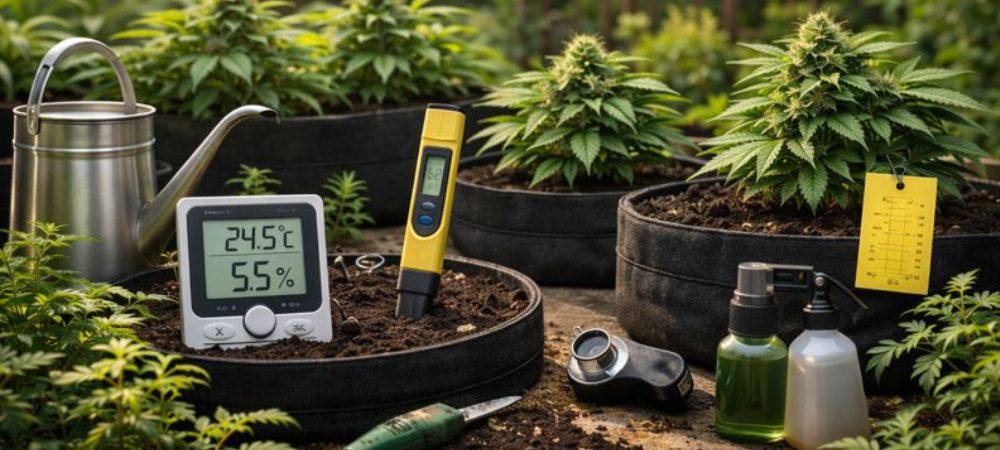
Tools for growing marijuana are not an expense, but an investment in control, quality, and peace of mind. Starting with the right equipment makes the difference between an improvised grow and an efficient, stable, and productive one.
Choosing well from the beginning will allow you to learn faster, enjoy the process, and achieve better results harvest after harvest.



 Add as preferred source in Google