Personalized Attention +44 151 947 0713
 SHIPPING TO ALL

 9/10 Rating
 SALE TO MINORS PROHIBITED


All growers may at some point need to root cuttings, as it allows to preserve certain desired characteristics of the plants. Products such as Clonex can help in this task. However, there are other methods and products that serve as alternatives to their use. This article tells all about them.
What is Clonex?
Clonex is a rooting product containing growth hormones specifically designed to stimulate root development in plant cuttings. It uses the active ingredient indolbutyric acid (IBA), in liquid or gel form, to accelerate root growth and increase the amount of roots formed, thus facilitating fast and efficient plant propagation by cuttings. Clonex is known for its effectiveness in promoting a healthy and robust root system.
The potency of Clonex is due to the fact that it is a live rooting hormone, something that none of the rooting hormones offered by other brands have, but it is also responsible for the fact that it is banned from sale.

Why clonex was banned in Spain?
Clonex was suspended in Spain, as well as throughout the European Union in 2015 due to legislative and bureaucratic problems related to the registration of one of its components, indolbutyric acid (IBA). This component was not registered in accordance with the new EU regulations, which prevented its commercialization. However, this situation has now been resolved and Clonex is once again available for sale in Europe.
On the other hand, this product was one of the most widely used for making cuttings because of the live hormone it incorporated, but here we explain how to make cuttings without Clonex.
Alternatives to using Clonex
Some of the stimulators and hormones that can be used to make your own cuttings include the following:
Root Riot Clonex Starter Plugs
Root Riot Clonex Starter Plugs is a proposal of the brand itself creator of Clonex, with which to make marijuana cuttings. This product consists of plugs already rich in rooting hormones. These have the perfect humidity, so you just have to take the cutting and place it inside.

ClonFix
ClonFix by Hesi became the most widely used cloning gel after the disappearance of Clonex, as growers are still looking for a formula that guarantees maximum speed, something that only a formula as rich in natural auxinsas this one can offer. While Clonex produces plants that root in approximately 10 days, other gels take a minimum of 18 to 20 days.
Rootech Cloning Gel
Rootech Cloning Gel by Technaflora is one of the most similar rooting gels to Clonex available, as both come in gel format and are also composed of hormones. The difference is that Rootech Gel does not incorporate the same hormones as Clonex, this cloning gel contains a hormone that increases root development.
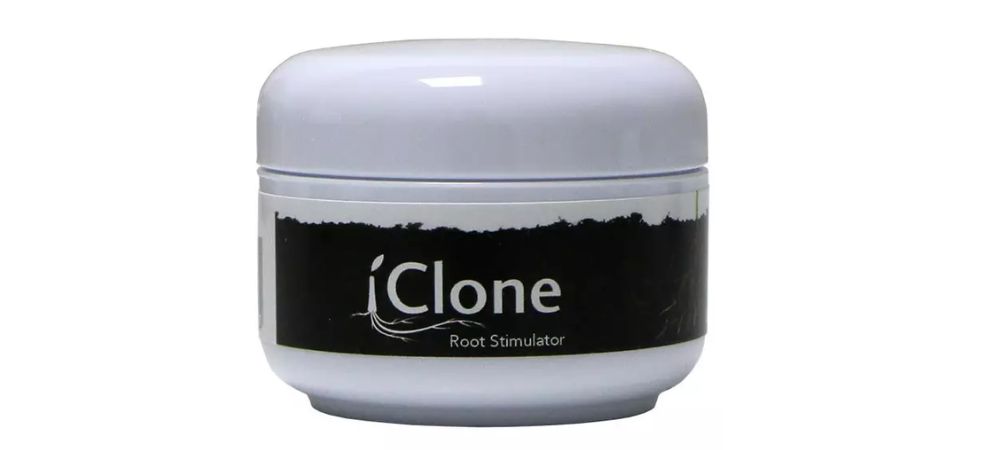
IClone Gel
IClone Gel also guarantees a very high percentage of success, although perhaps the development of the roots is a little slower, so they will need a little more time before being able to feed through the roots. Within its composition, it is worth mentioning the presence of extracts of Ascophyllum Nosodum, a typical seaweed of the North Atlantic Ocean, very rich in organic acids, polysaccharides, amino acids and proteins.
Root It Rooting Gel
Root It Rooting Gel is possibly the most unique rooting liquid of all those available in our catalog. It can be applied directly to the substrate in which the clone is to be placed, which makes rooting much easier. By penetrating directly into the substrate, the roots will grow by feeding on the rooting agent itself, which will ensure a large presence of roots quickly.
Natural Clone by Trabe
Natural Clone by Trabe is perhaps the most natural rooting gel in the entire catalog, as it comes entirely from seaweed extracts, rich in cytokinins, amino acids, betaines and vitamins.
All the gels on this list are very easy to contaminate, although with this one you will have to be even more careful, so it is recommended to take out the right amount of gel to be used and not to put it back into the pot, as it could get contaminated.
These are just some of the most popular stimulators available on the market, as there are hundreds of possibilities. What is recommended is to experiment until you find the one that works best. The same fertilizer used in different areas, with different characteristics, will offer different results, so you just have to find the one that best suits each crop and its characteristics.
These are only the best known, you have a market with hundreds of possibilities, so you should try until you find the one that works best for you. The same fertilizer used in different areas, with different characteristics, will offer different results, so you just have to find the one that best suits your system and growing conditions.