Personalized Attention +44 151 947 0713
 SHIPPING TO ALL

 9/10 Rating
 SALE TO MINORS PROHIBITED

Thrips are one of the most frequent and annoying pests that can affect cannabis crops. These tiny insects can cause significant damage if not controlled in time. Stopping them early and preventing their spread can make a huge difference. In this article, we’ll discover the common types of thrips that affect marijuana plants.
What are thrips?
Thrips are tiny insects, usually less than 1 mm long, that belong to the order Thysanoptera. They’re among the most frustrating pests for growers. These intruders feed on plant sap by piercing leaf cells and sucking out their contents.
This weakens the plant, spreading viruses and diseases, damaging leaves and flowers, and ultimately reducing both quality and yield.
Common types of thrips in cannabis
While their effects can be severe if not addressed quickly, there are several types of thrips that can infest cannabis. Learn to identify and fight the most common ones below.
The 5 most common thrips species include:
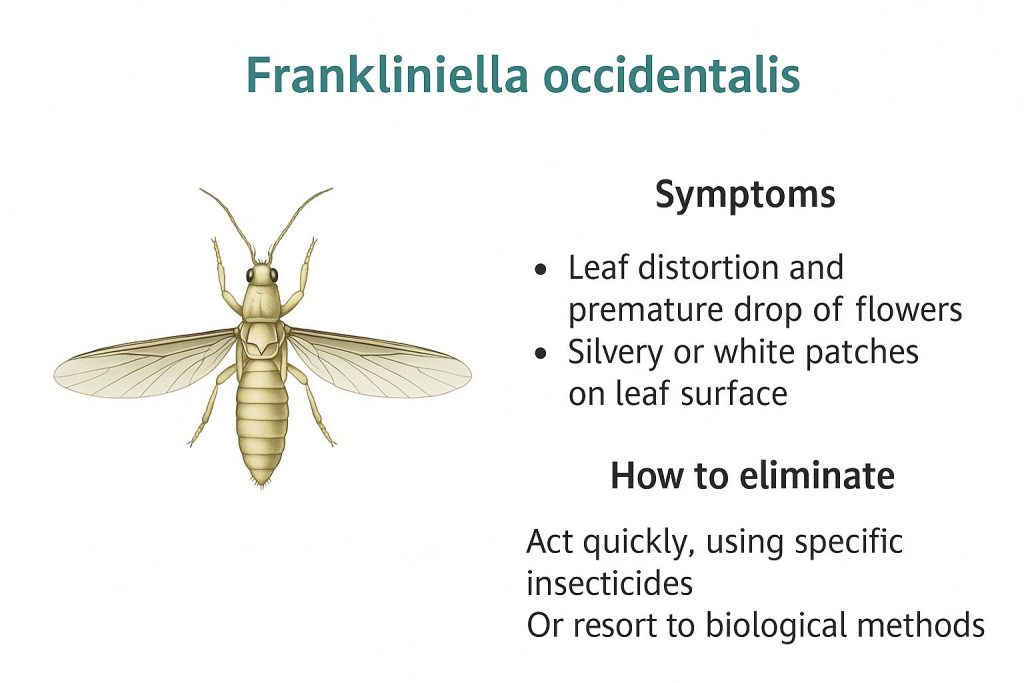
Chaetanaphothrips orchidii: The orchid invader
As the name suggests, this thrips species is mostly found on orchids, but it can also impact cannabis plants.
What damage does it cause?
Chaetanaphothrips orchidii feeds on leaf tissue, leaving spots and weakening the plant, often causing irreversible damage.
How to identify them?
Look for discolored and wilted leaves. Check with a magnifying glass to confirm the presence of these pests.
Solution:
To combat these thrips, use neem oil or potassium soap or introduce natural predators such as Amblyseius swirskii to control this pest. These predators allow you to control all types of pests, as they are mites that devour the larvae, serving also as a preventive
Dichromothrips corbett: Orchid menace
Similar to the previous one, this thrips species targets orchids but can also affect nearby cannabis crops.
What damage does it cause?
These thrips feed on plant sap. In addition, their activity can cause tissue necrosis, reduced growth and reduced crop yields. It also acts as a vector of phytopathogenic viruses, which further aggravates the impact on infested plants.
How to identify them?
Check for:
- Discoloration and leaf weakening.
- Irregular spots and dry areas.
- Shake the plant over white paper to spot the insects.

Solution:
Apply neem oil or, in severe cases, use specific chemical insecticides.
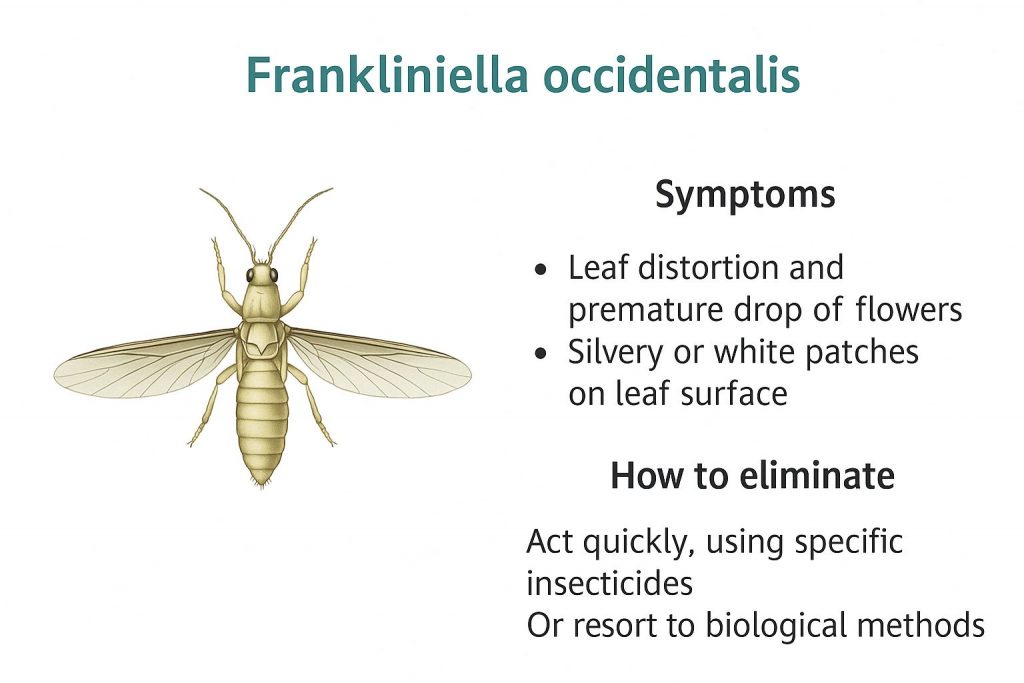
Frankliniella occidentalis
One of the most common thrips in cannabis, capable of causing significant damage.
What damage does it cause?
Feeds on leaves, leaving silver or white spots. In severe cases, it may deform leaves and cause early flower drop.
How to identify them?
Look for silver-white marks and tiny black dots (excrement) on leaf surfaces. Gently shake the plant over white paper to see them move.
Solution:
Act quickly using targeted cannabis insecticides or biological control methods like introducing predatory insects.
Thrips setosus: The threat to hydrangeas
This is a type of thrips that is most commonly found on hydrangeas but can also affect marijuana crops if the conditions are right.
What kind of damage can it cause?
This type of thrips can cause damage to crops by interfering with photosynthesis. In advanced infestations, the plant may show stunted growth.
How can they be identified?
Their attack causes necrotic spots on leaves and can reduce the plant’s photosynthesis. Leaves may show brown spots and irregular edges.

What’s the solution?
Among other options, biological control using Amblyseius swirskii is a great choice, along with the use of natural insecticides like neem oil.
Thrips tabaci: A challenge for onion growers
Thrips tabaci is one of the most common types of thrips in onion and other vegetable crops, although it can also be a problem for nearby marijuana crops.
What kind of damage can it cause?
Their feeding causes deformed and weakened leaves, affecting the plant’s overall growth.

How to detect Thrips tabaci?
Leaves show a yellowish hue and may have small perforations. If you inspect with a magnifying glass, you can spot the thrips.
What’s the solution?
To eradicate them, it is recommended to use blue sticky traps, apply potassium soap, and in severe cases, systemic insecticides.
Other common types of thrips
In addition to the most common thrips pests, there are other species that may affect marijuana crops. Below is a brief list of other types of thrips and how to identify them:
- Red-banded thrips (Selenothrips rubrocinctus): cause silver spots and leaf deformations. To avoid them, use specific insecticides or natural predators like Orius laevigatus.
- Heliothrips haemorrhoidalis: greenhouse thrips: these damage leaves and flowers, causing discoloration and deformities. It is advisable to apply organic insecticides like Spruzit® or use anti-thrips mesh.
- Citrus thrips (Scirtothrips citri): damage leaves and young shoots, reducing plant growth. They show silver spots and deformations on new leaves.
- Parthenothrips dracaenae (palm thrips): cause silver spots and weaken the plant. To stop them, you can use Compo Bio Stop Insecticide Spray for quick control.
The best products for all Kinds of thrips
To eliminate thrips in cannabis cultivation, you can use different cannabis insecticides or biological control methods. Some of the most commonly used are:
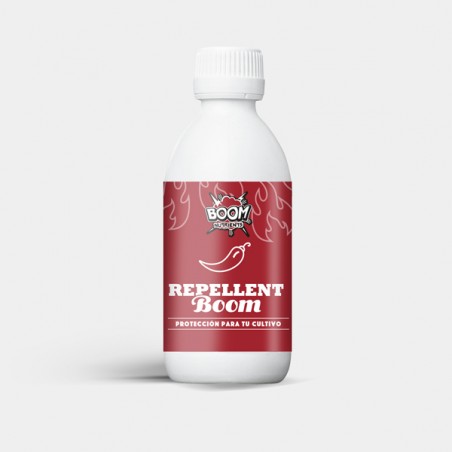
Repellent Boom
Repellent Boom by Boom Nutrients is the best insecticide for thrips, being a natural repellent that protects against these and other insects. Its liquid formula, based on plant extracts, makes it safe for cultivation and effective for preventing and controlling infestations. This insecticide contains a high amount of capsaicin and works by irritating the pests’ sensory receptors, deterring their presence and strengthening plant resistance. It can be applied foliar (1–2 ml/L) or directly to the substrate (2 ml/L) for maximum effectiveness.
Repellent Boom
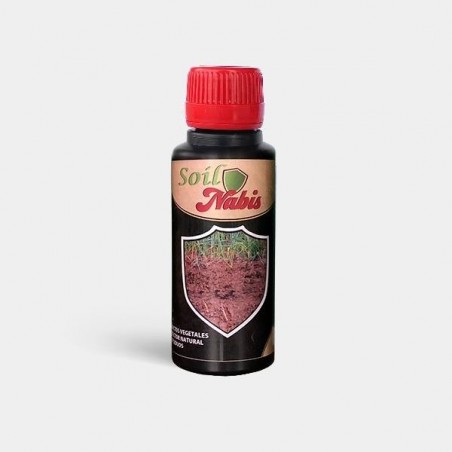
Soilnabis Soil Insecticide
Soilnabis Soil Insecticide is designed to be applied directly into the substrate, eliminating thrips and other soil-dwelling pests and preventing them from reaching the plant. Thanks to its formula with extracts of *Tagetes erecta* and *Ascophyllum nodosum* algae, it contains Alpha-terthienyl, a toxic metabolite for larvae and soil insects, offering effective defense against thrip infestations like soil flies.
SoilNabis Soil Insecticide
Anti-Thrips and insect netting
The Anti-Thrips and Insect Net is a physical solution to prevent the entry of thrips and other insects into the crop, without needing insecticides. It is especially useful for outdoor grows. This mesh is made from durable materials, so it can be used to individually wrap outdoor plants.

Anti-Insect net
Orius Laevigatus against thrips
Orius Laevigatus is a natural predator of thrips. This small insect feeds on thrips in all life stages, providing effective and sustainable biological control. It is highly effective against thrips, red spider mites, and small caterpillars in both indoor and outdoor grows. This miniature beetle sucks its prey with its beak, leaving only the exoskeleton. It is recommended to use it after applying a biological insecticide and blue traps to reduce the pest.

Orius Laevigatus Thrip Biocontrol
Bio Stop Spray Insecticide by Compo
Bio Stop Spray Insecticide by Compo is an organic and natural ready-to-use product that effectively fights thrips and other pests. Its spray format makes it easy to apply directly on the plants until moist. It is recommended for use in the morning and evening. Suitable for indoor and outdoor use, with variable dosage depending on plant size. This thrips insecticide acts through contact and ingestion, suffocating insects and eliminating eggs, larvae, and adults.
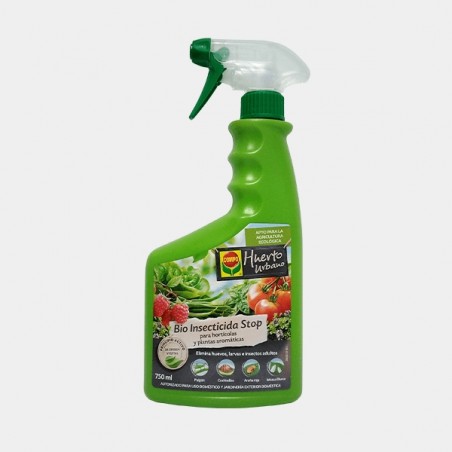
Bio Stop Compo Spray Insecticide
Product comparison for thrips
| Product | Product Type | Mode of Action | Effectiveness | Crop Safety |
| Repellent Boom | Natural insecticide | Repellent | High | High |
| Soilnabis Soil Insecticide | Soil insecticide | Soil elimination | Medium-High | High |
| Anti-Thrips Net | Physical barrier | Prevention | High | High |
| Orius Laevigatus | Biological control | Natural predator | High | High |
| Spruzit® Insecticide | Eco insecticide | Contact | High | High |
| Bio Stop Insecticide | Ready-to-use insecticide | Contact | Medium-High | High |
The different types of thrips are pests that can cause serious damage to cannabis crops, but with the right products and methods, they can be effectively controlled.




 Add as preferred source in Google