Personalized Attention +44 151 947 0713
 SHIPPING TO ALL

 9/10 Rating
 SALE TO MINORS PROHIBITED


Talking about CBD for epilepsy means entering a delicate subject that sparks a lot of interest, but also quite a few doubts. More and more people are looking for information on the relationship between CBD and epilepsy, whether because they are living with an epilepsy diagnosis, supporting a family member, or because they have heard about CBD in contexts related to the nervous system.
In this guide, we are going to explain what epilepsy is, what CBD is, why there is interest in this combination, and what factors are worth considering before interpreting any information about CBD for epilepsy. The goal is not to make promises, but to help you better understand the context, distinguish useful information, and separate realistic expectations from imprecise messages.
What is epilepsy?
Epilepsy is a neurological disorder in which periodic seizures occur, caused by an alteration in the brain’s electrical activity. Although many automatically associate it with visible convulsions, the truth is that it manifests in different ways. There are very different types of seizures, with intensities, durations, and symptoms that can vary from one person to another.
That is why, when looking for information about CBD for epilepsy, it is important to start with a basic idea: there is no single form of epilepsy or a single experience associated with it. The type of seizure, age, origin of the condition, frequency of occurrence, and response to treatments mean that each case has its own context.
What is meant by epilepsy?
We speak of epilepsy when a person has a tendency to suffer from recurrent epileptic seizures. These seizures occur because certain electrical signals in the brain are temporarily altered. Furthermore, they generate manifestations that can range from brief absences to more intense episodes with involuntary movements.
Why are not all epilepsies the same?
Epilepsy has different ways of presenting itself. Some appear in childhood, others in adulthood. Certain ones respond better to treatment, while others prove to be more complex to control. There are also rare epileptic syndromes that are approached differently than other more common conditions.
For this reason, any information about CBD for epilepsy should be interpreted with caution. What is observed in a specific case cannot be automatically transferred to another. The clinical context, the progression, and previous treatment are factors that completely change the interpretation of any data.
CBD for epilepsy: how are they related?
CBD, or cannabidiol, is one of the compounds present in the cannabis plant. In recent years, it has become especially popular because it differs from THC in a key point: it is not associated with psychoactive effects. In other words, it does not produce the “high” associated with cannabis.
Beyond the recreational sphere, CBD has sparked interest in conversations related to wellness, the nervous system, and cannabinoids. In the case of CBD for epilepsy, that attention is explained above all by research developed in certain specific clinical contexts, which has made more and more people want to understand what is really known and what should not be taken for granted.
What exactly is CBD?
CBD is a cannabinoid, that is, one of the many compounds found within cannabis. Depending on the type of extract and how it is formulated, it can be presented in oils, capsules, or other formats. Even so, it is not advisable to group all products under the same category, because talking about cannabidiol is not the same as talking about any product with cannabis, nor about a specific medical formulation.
Key differences between CBD and THC
| Difference | CBD | THC |
|---|---|---|
| Type of cannabinoid | Cannabidiol | Tetrahydrocannabinol |
| Relationship with cannabis | Comes from the plant itself | Comes from the plant itself |
| Main effect | Not associated with psychoactive effects | Associated with psychoactive effects |
| Role of CBD in epilepsy | Usually the focus of information searches | Element of comparison or possible confusion |
| Oils and extracts | Isolated, broad-spectrum, or full-spectrum products | Traces or formulations with a higher presence |
| What to check before evaluating | Total CBD, type of extract, certificates, and analysis | In what quantity and how it is reflected on the label |
Understanding these differences between CBD and THC is key. Many of the confusions about CBD for epilepsy begin precisely by mixing cannabidiol, THC, medical cannabis, and commercial products as if they were part of the same category. In reality, not all these concepts mean the same thing nor are they interpreted the same way within an informative or clinical context.
How does CBD interact with the nervous system?
To understand why there is so much talk about CBD for epilepsy, it is worth looking at the relationship between CBD and the nervous system. Part of the interest generated by cannabidiol comes precisely from how it interacts with certain mechanisms of the body.
Even so, the fact that this interaction exists does not mean that everything said about it is well interpreted. It is at this point that many misunderstandings often appear, especially when general dissemination is confused with overly direct conclusions.
Relationship with the endocannabinoid system
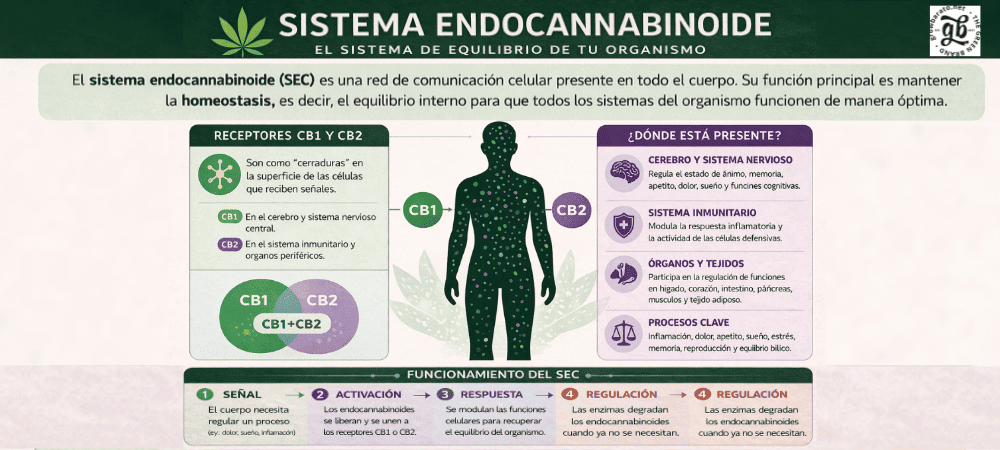
When talking about CBD for epilepsy, one of the concepts that appears most is the endocannabinoid system. It is a network within the body itself that participates in the regulation of different functions and in the maintenance of internal balance. Within this system, receptors such as CB1 and CB2 are involved, as well as compounds that the body produces naturally and enzymes that regulate them.
Why is it studied in neurological disorders?
The interest arises, in part, because cannabidiol is studied in relation to mechanisms of the body linked to the nervous system and neuronal signaling. That basis explains why it appears so frequently in content about neurology, cannabinoids, and the body’s internal balance.
Now, it is worth making an important distinction regarding CBD for epilepsy: just because CBD is researched in this area does not mean there is a single answer for every case. Furthermore, in epilepsy, the most solid evidence is concentrated primarily on some rare and specific forms. This forces one to interpret any information with considerable caution.
What does it really mean that CBD for epilepsy can help?
When it is said that CBD “can help” with epilepsy, it does not mean that it replaces an antiepileptic treatment on its own. In reality, that phrase is usually used to talk about an existing interest in specific contexts where cannabidiol has been studied more, or where certain formulations have been valued within a specific medical framework. Therefore, the important thing is to understand in what situations it is discussed, with what type of product, and under what context.
It is also advisable to avoid thinking that “can help” means the same as “is proven for any epilepsy.” It is not. Epilepsy includes very different realities, and information cannot be automatically transferred from one case to another. Therefore, the most responsible way to interpret this expression is to understand that it speaks of a possibility that depends on many factors, not a guarantee. In this subject, “can help” means that there is interest, research, and clinical conversation in some cases.
CBD for epilepsy: why does it generate real interest?
The interest in CBD for epilepsy is not born from a simple trend, but from the search for complementary alternatives in cases where seizures do not always respond the same way to standard treatments.
Increased interest in recent years
The medical use of CBD has gained visibility because many people with epilepsy continue to look for information about CBD for epilepsy when seizure control is not simple, or when they want to better understand what options are available. Added to this is a greater public presence of CBD and a constant circulation of content that mixes dissemination, commercial products, and medical news, which often increases confusion.
Difference between therapeutic interest, clinical context, and personal use
When talking about CBD for epilepsy, many doubts come from mixing scenarios that actually work very differently. To interpret any information about CBD for epilepsy well, it is important to understand from what point it is being discussed and what type of framework is behind it.
| Focus | What it is | Where it is situated | Level of control | What it implies |
|---|---|---|---|---|
| Therapeutic interest | Research and study of cannabidiol in specific contexts | Scientific studies and treatment development | High, based on protocols and evolving evidence | Helps to understand why it is researched, but does not imply direct or generalizable use |
| Clinical context | Use within a medical environment with diagnosis and follow-up | Hospitals, specialized clinics, and supervised treatments | Very high, with dose control, follow-up, and medical evaluation | Refers to specific formulations and specific cases, not just any product |
| Personal use | Consumption of products available in the general market | Specialized stores or online sales | Variable, depends on the product and its transparency | Does not equate to medical treatment and should not be interpreted as such in epilepsy |
Understanding these three levels helps to read information with more judgment and not to mix concepts that belong to completely different contexts.
What does current evidence say about CBD for epilepsy?
Today, the most solid data on CBD for epilepsy is concentrated on specific and rare forms. Especially in Dravet and Lennox-Gastaut syndromes, and in tuberous sclerosis complex when talking about approved pharmaceutical cannabidiol. In those specific cases, it has been studied as a complementary treatment and not as a generic solution.
That is a key difference, because it is often overlooked that the most consistent research on CBD for epilepsy does not focus on just any CBD oil. It focuses on specific formulations, under clinical follow-up, and in patients with very specific conditions. This does not mean that the interest is small, but that it must be understood well.
Precisely because part of the evidence is relevant, it is also worth explaining its limits. Not all types of epilepsy have been studied equally; doubts still exist in other clinical profiles. What is observed in Dravet or Lennox-Gastaut cannot be automatically transferred to any person with epilepsy.
Likewise, along with the interest in efficacy, one must also keep in mind aspects such as adverse effects and interactions with other antiepileptics. Among the most frequent effects are drowsiness, decreased appetite, diarrhea, or vomiting. Elevated transaminase levels have also been noted in some cases.
In which types of epilepsy is information about CBD usually sought most?
The interest in the use of CBD for epilepsy seizures is not distributed uniformly among all diagnoses. The search usually focuses on cases where seizures are difficult to control, in rare syndromes with more attention in research, and in situations where the family, or the person, wants to understand the difference between a commercial product with CBD and a supervised medical use of cannabidiol.
Treatment-resistant epilepsies
When seizures persist despite the use of several drugs, it is common to explore other types of treatments regarding CBD for epilepsy. Complementary therapies, trials, approved medications, or new lines of research.
Dravet Syndrome
Dravet syndrome is one of the names that appears most when talking about CBD for epilepsy, and it is no coincidence. It is one of the conditions where pharmaceutical cannabidiol has been studied the most.
The Epilepsy Foundation summarizes that, in a study of 120 children and adolescents with Dravet, 43% of those who received Epidiolex had a reduction of more than 50%, compared to 27% in the placebo group. It also recalls that in this context, adverse effects such as diarrhea, vomiting, fatigue, and liver test alterations were observed more frequently.
Lennox-Gastaut Syndrome
It is a complex epilepsy, with different types of seizures and a significant impact on the quality of life, both of the diagnosed person and their environment, so any information about approved treatments or lines of research usually sparks a lot of interest.
Tuberous sclerosis complex
It is part of the approved indications for prescription oral cannabidiol. This makes it another of the diagnoses where the search for information can be especially intense, especially in families trying to clarify whether they are reading about a specific medication, about commercial CBD, or about medical cannabis in a broad sense.
Pediatric cases versus adult cases
A large part of public interest is born in pediatric contexts, especially when the diagnosis is rare or difficult to control. In adults, many reviews point out that there are more evidence gaps, such as in certain focal epilepsies. This forces one to interpret the data with more caution.
Differences between commercial CBD and supervised medical use
Although both may share the name of the compound, they are not on the same plane nor should they be interpreted in the same way. The FDA (Food and Drug Administration, USA) has approved Epidiolex, an oral solution for the treatment of seizures in Dravet and Lennox-Gastaut syndromes, and tuberous sclerosis complex in patients one year of age or older.
In contrast, when we talk about oils, extracts, or CBD supplements marketed in the general market, we enter a very different scenario. These products do not automatically equate to a medication, nor do they necessarily share the same concentration, purity, stability, or level of control as an approved pharmaceutical formulation.
On the other hand, when a CBD product is evaluated, the concentration, purity, and quality control completely change its interpretation. In the pharmaceutical field, the formulation used in epilepsy responds to very specific parameters of composition, dosage, and follow-up. In the general market, however, there can be notable differences between apparently similar products, both in the actual amount of cannabidiol and in the presence of other compounds such as THC.

It should be kept in mind that epilepsy is not valued only by the name of the diagnosis, but also by the frequency of seizures, medication, response to previous treatments, progression, and each person’s tolerance. When it comes to uncontrolled epilepsy or complex conditions, any assessment regarding medical cannabis should be done together with the healthcare team.
Important factors before evaluating the use of CBD for epilepsy
Before evaluating the use of CBD for epilepsy, there are several factors that show why it is not distributed equally among all clinical profiles.
Type of epilepsy and seizure frequency
The type of epilepsy matters because the greatest clinical support is concentrated on Lennox-Gastaut, Dravet, and tuberous sclerosis complex. Added to this is the frequency and severity of the seizures, since evaluating a well-controlled condition is not the same as evaluating a treatment-resistant or complex-progression epilepsy.
Age and context
In the case of Epidiolex, it can be used in patients one year of age or older. Furthermore, age is not valued in isolation, because the clinical moment also matters: frequency of seizures, current treatments, presence of other pathologies…
Current treatments
Current treatments should always be reviewed, as approved CBD for epilepsy is used as an add-on therapy. Clinical assessment depends on how it fits with the already prescribed medication and the progression of the seizures.
Possible interactions and need for medical review
Many people who suffer from epilepsy and look for information about CBD for epilepsy follow combined treatments. Some of these drugs can modify the safety profile of cannabidiol or be affected by it. CBD is capable of increasing the levels of its active metabolite, which can intensify effects such as drowsiness or sedation.
Another key point is the combination with valproate. Their combined use can increase the risk of elevated transaminases and other liver alterations. Therefore, it is recommended to monitor liver function before starting treatment and during follow-up.
Medical reviews help to see if there are interactions with other antiepileptics. They also serve to monitor possible adverse effects and check tolerance, allow for deciding if a dose adjustment is needed, and even help to rethink the combination if necessary. This supervision becomes even more important in complex epilepsies, multiple treatments, or pediatric profiles.
CBD formats and differences in use
CBD oil is the most used format in the general market and in informative searches. However, we must distinguish between a commercial oil and a pharmaceutical cannabidiol formulation. Not every product in this format responds to the same level of control, nor does it share the same composition.
In epilepsy, the clearest reference is Epidiolex, which is formulated as an oral cannabidiol solution. Its concentration is defined as 100 mg/ml, which allows for working with a precise dosage and within a regulated framework of use.
There are also capsules and other oral formats, but the presentation does not change the fact that, in epilepsy, the decisive element remains the formulation profile, in addition to its quality control and the context in which it is used.