

 Personalized Attention +44 151 947 0713
 SHIPPING TO ALL


 9/10 Rating
 SALE TO MINORS PROHIBITED
 Iniciar sesión
 0

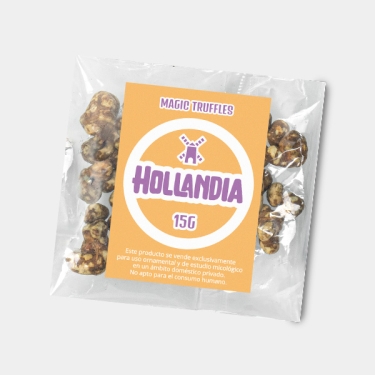
Hollandia truffles are one of the most famous varieties in the mycological catalog.
Subscribe and we'll let you know when we have stock.
 1
loyalty point.
Your cart will total 1
loyalty point
that can be converted into a voucher of
0.20€

Description
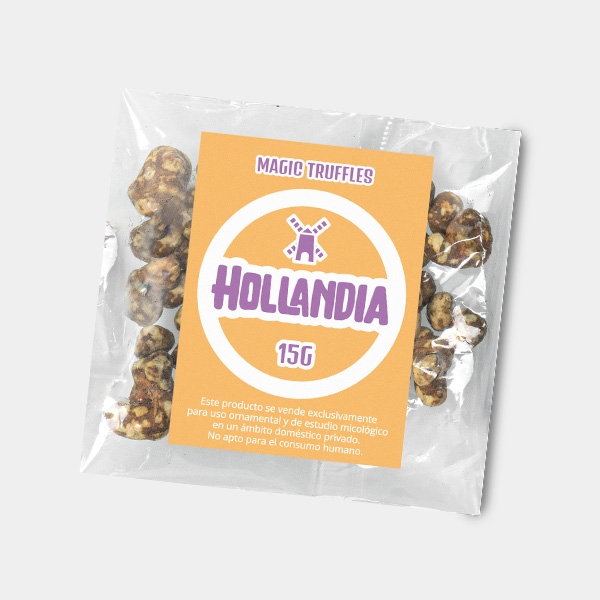
Hollandia truffles are one of the most well-known and sought-after varieties in the truffle catalog. Their popularity is due to their recognizable appearance and their status as a common reference among those seeking information on sclerotia with a distinct character within the mycological field.
Visually, Hollandia truffles have a compact appearance, irregular shapes, and brown tones that can vary slightly between lighter and darker shades. Their dense appearance and careful presentation make them stand out among premium varieties.
From a mycological perspective, it is not a conventional mushroom, but rather a sclerotium: a subterranean structure formed by the mycelium of the fungus to store nutrients and withstand adverse conditions. This particularity explains both its shape and its informational interest within the catalog.
This product is intended exclusively for ornamental or mycological study purposes. It is not intended for human consumption.
Hollandia truffles naturally contain psilocybin and psilocin, compounds present in certain fungi and their sclerotia.
The concentration of these compounds may vary depending on factors such as production, batch, and storage conditions.
Each package of Hollandia truffles includes:
This format helps maintain the product's conditions better until opened and offers a practical presentation for refrigerated storage.
To properly preserve Hollandia truffles, it is recommended to keep them refrigerated between 2 °C and 4 °C and store them in their vacuum-sealed packaging while it remains closed. Once opened, they will lose their properties within a maximum of 3 days. For long-term preservation, the truffles should be dried; they would then last about 2 years in an airtight container in a cool, dry, and dark place.
The Hollandia variety was developed in the Netherlands, one of the most recognized territories in the magic truffle sector, hence its name. Its origin is related to laboratory production processes aimed at obtaining a stable, recognizable variety with an optimized concentration of its natural compounds.
Over time, Hollandia has established itself as one of the most popular varieties in the catalog, both for its notoriety and its differential profile compared to other references.
Hollandia truffles are sclerotia, a compact structure that forms underground from the fungus's mycelium.
The mycelium is the vegetative network of the fungus, and the sclerotium acts as a nutrient reserve. Its main function is to store resources and help the organism survive in less favorable conditions.
Therefore, although often compared to mushrooms, Hollandia truffles are not a conventional mushroom, but a distinct subterranean formation within fungal development.
Hollandia truffles are sclerotia, a subterranean structure formed by the mycelium of the fungus to store nutrients. They are not a conventional mushroom, although they are part of the same mycological field.
Hollandia is considered a high-intensity variety. It is usually placed above milder references such as Mexicana or Atlantis and is commonly compared to potent varieties like Ragnarok.
It is recommended to store them between 2 °C and 4 °C, preferably in their original vacuum-sealed packaging. Unopened, they can last approximately one week. Once opened, they should be kept refrigerated and used within a maximum of 2 to 3 days.
Their appearance, texture, and stability largely depend on preservation. Maintaining the cold chain and not opening the package prematurely helps preserve their characteristics better.
This product is intended exclusively for ornamental or mycological study purposes. It is not intended for human consumption.
You might also like


06/05/2026
Is it normal for the vacuum packaging to be bloated?
Translated from Spanish
El envasado al vacío, es normal que este inflado?
1 person found this comment helpful.
08/10/2025
Funny
Translated from Portuguese
Engraçados
08/10/2025
Good.
Translated from Spanish
Bien.
17/06/2025
very goooood, goood very good man
Translated from Spanish
muy buenooo, goood very good man