Personalized Attention +44 151 947 0713
 SHIPPING TO ALL

 9/10 Rating
 SALE TO MINORS PROHIBITED

Pruning marijuana is a process that can provide many advantages to cultivation. The main goal of this practice is to balance the allocation of energy that the plant uses for various resources. To learn how to prune a cannabis plant and the different types of pruning, here is all the information.
Why Prune Marijuana
Pruning marijuana has several benefits for your plants, including:
- Improved bud quality: Pruning concentrates the energy and nutrients on bud formation, leading to increased resin production and quality.
- Size and Shape Control: Especially useful for indoor cultivation where space is limited, pruning allows for control over the plant’s size and shape.
- Better Air and Light Flow: Pruning improves airflow and light penetration, maintaining a healthier environment for the plants.
How to prune a cannabis plant
Depending on the plant and desired outcomes, you can choose from various types of marijuana pruning techniques. While there are many types, some of the most commonly used ones include:
Apical Pruning in Marijuana
Apical pruning involves cutting the main tip of the plant, known as the apical or terminal bud, where leaves are attached directly to the stem. This results in a Y-shaped branching pattern.
The aim is to slow down vertical growth and redirect more energy to the lateral branches, creating a bushier plant with a moderate size. This type of pruning is often done when using a SCROG setup to gain width while sacrificing height, which is ideal for tall sativas with long flowering periods.
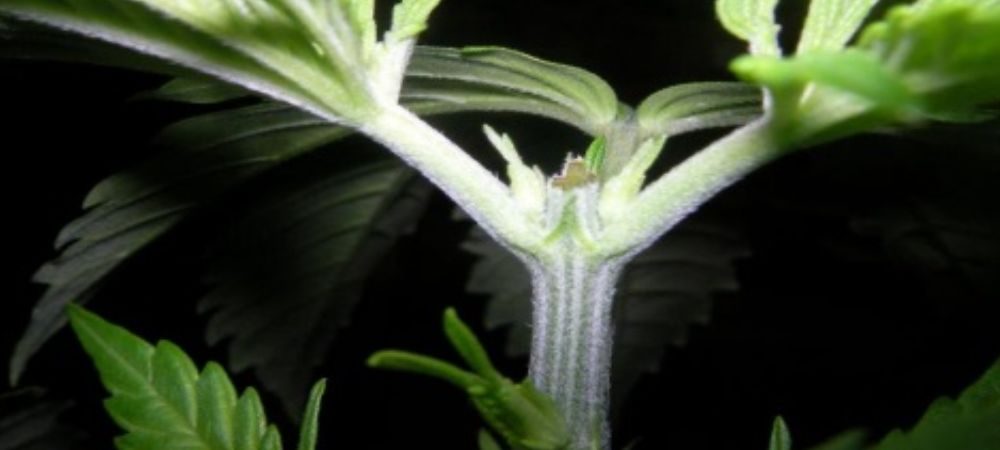
To perform apical pruning, identify the part of the plant to cut, which is the apical or terminal bud where leaves attach directly to the stem. This area has a high concentration of auxins used for the growth of secondary branches.
Start apical pruning from the third set of leaves and cut the central stem above the third node counting from the bottom.
If a large hole is left in the stem where air or dirt can enter, it should be sealed with plant scar tissue paste to prevent rot. If you can’t find scar tissue paste, you can use a small amount of candle wax, although it won’t last as long as the first mentioned product.
Wait for new shoots to grow and recognize them as central tips. The plant will distribute the production it was going to give in one tip evenly between the two, as they will be at the same height and both recognized as central. You can continue pruning it as it grows during the vegetative phase.
FIM Pruning in Marijuana
FIM pruning is similar to apical pruning as both involve cutting the upper growth tip. However, with FIM pruning, approximately 80% of the new growth tip is cut, leaving about 20% intact. The result of this pruning is the development of 4 to 6 new main stems at the top of the plant to increase yields with a simple cut. The key for a successful FIM pruning is not to completely remove the central eye of the plant, as it will turn into an apical pruning.
This type of pruning is advantageous for mother plants. When starting with a new cutting to create a new mother plant, FIM pruning can be done with younger plants, ensuring the maximum number of eyes from the beginning. A good mother plant should have many eyes from which to take branches, and this pruning technique achieves that right from the start.
To perform FIM pruning, find the third node and make the cut in the next node, similar to apical pruning. You will need to cut two-thirds of the new growth, leaving only the stem and the beginning of the new leaves.
Wait for the plant to grow and recover. In cases where there is a long vegetative growth period, such as outdoor plants, this can be done 2 or 3 times before flowering. This technique results in a large cluster of buds, ideal for outdoor cultivation in areas where discreet and camouflaged plants are necessary.

Lollipop or Low Branch Pruning
Lollipop pruning involves removing lower branches to focus more energy on the central cola of the plant. It is commonly used in indoor cultivation to allow for closer spacing of plants and to expose all plants’ most productive parts to light. The objective is to achieve strong vigor in the upper third of the plant. This increases production, as there are no lower branches far from the light, meaning those branches that do not produce effectively.
To perform lollipop pruning correctly, follow these steps:
- Plant 16 to 25 seeds per grow light.
- Provide normal growth until around day 15-18 from germination, then switch to the flowering stage.
- Plants will grow in height, but their lateral growth will be limited due to the high plant density.
- Once the first signs of flowering appear, it’s an indication that it’s time to prune.
- Remove all lower branches, leaving essentially only the central tip and one or two nodes at most.
- Place stakes on the plants as they will grow tall and slender. If they are not helped to support the weight of the central cola, the cells of our plants will focus on creating the stem. If they are aided with stakes, they will continue to fatten until the last moment, giving maximum strength to the flower.
- In a short time, they will stabilize in flowering and have a canopy of buds with hardly any leaves to manicure.
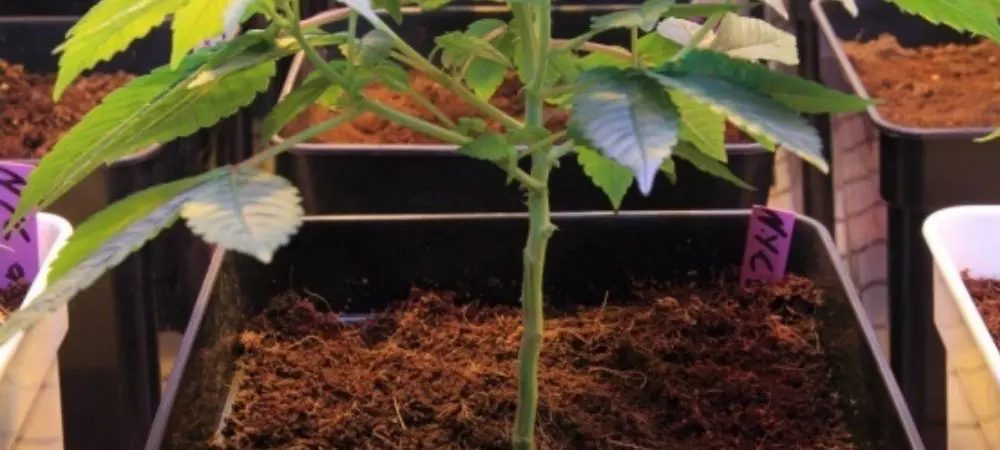
How to prune a cannabis plant with LST
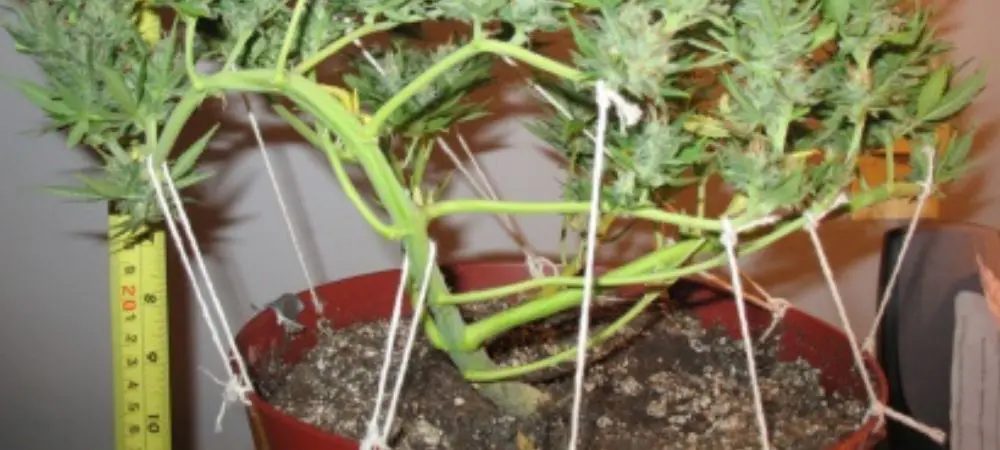
LST (Low Stress Training) in marijuana cultivation is a technique primarily applied in indoor growing. Still, over time, many outdoor growers have adopted this method due to its advantages. LST allows for the combination of the benefits of apical pruning with bending techniques to encourage horizontal plant development.
However, each grower decides when to apply the LST system, as this technique controls the height while harnessing the amount of light emitted either by high-pressure lamps or natural sunlight.
Each ray of light or lumen decreases in intensity as it encounters obstacles in its path through the plant, whether leaves, branches, or shadows cast from other sources. LST is undoubtedly the most effective way to utilize the lumens from bulbs. Therefore, it results in a greater quantity of buds in the final flowering phase of marijuana plants. To perform LST:
- Begin with an apical pruning.
- Two lateral branches will emerge, which will need to be tied to stakes as they grow. The idea is to spread them to cover the maximum surface area.
- Vertical stems will grow from each horizontal branch, where the buds will develop.
LST can be combined with other techniques like apical pruning, resulting in more branches. These methods can be mixed in extended outdoor cultivation seasons, where the plant grows over several months.
These are some of the various answers to the question how to prune a cannabis plant in order to improve yields, suitable for all types of growers, climates, and cultivation spaces, both indoors and outdoors. We hope that this article has helped you to learn how to prune a cannabis plant.




 Add as preferred source in Google