 Personalized Attention +44 151 947 0713
 SHIPPING TO ALL


 9/10 Rating
 SALE TO MINORS PROHIBITED



The cultivation of cannabis involves different phases that must be understood and distinguished in order to know what the plant needs at each stage. In fact, errors during flowering can greatly affect the size of the plants and the quality of the harvest. However, by paying attention to various aspects, it will be easy to achieve large yields and know when to harvest. Below is an explanation of how long it takes for the buds to mature and the different phases that the plants go through.
How long do buds take to mature?
The timing of the appearance and development of flowers depends on the type of variety chosen. Therefore, it is necessary to know what the seed bank says about the ripening time or how to make the most of it. Besides, most cannabis varieties offer a flowering period of between 7 and 9 weeks. However, in some cases, sativas may need a little more time to mature.
Buds are generated during the flowering stage, which consists of different phases:
Preflowering
This is the moment when the plants begin to have the first flowers sprouting from the internodes. It is considered a few weeks of transition, so the plants will not stop growing suddenly. Additionally, many varieties may experience significant stretching and the small flowers will turn into dense and valuable buds. The duration of this phase is between 2-3 weeks, depending on the chosen seed, and it cannot be extended.

At this point, flowering stimulators are usually used, products that accelerate the internal flowering processes without affecting the flowering time. Therefore, it will produce more trichomes. It is important to take into account what happens during each week of preflowering:
Week 1 (transition and stretching): Plants are likely to grow rapidly as they understand that winter is approaching and they know they will soon be full of flowers. Some may even double in size during this time, hence the term “stretching phase.” In addition, they will develop a series of new leaves, especially at the top of the main stems. At this stage, a large number of leaves and stems develop to become a strong plant capable of supporting the weight of the buds, requiring a higher demand for growth nutrients.
Week 2: During this period, the first white pistils may appear on female cannabis plants. They usually appear where the large leaves meet the main stem. From these pistils, flowers will emerge. Conversely, male specimens will produce small pollen sacs. Once flowering begins and the first signs of bud formation occur, it is necessary to check the manufacturer’s recommendations.
Week 3: At this point, cannabis plants have not yet stopped growing completely and are 50% larger. Similarly, buds begin to appear but will have little resin or trichomes, resulting in a light aroma. This is an important stage of maturation because they increasingly require more energy for flower production, so attention must be paid to possible deficiencies or over-fertilization, which manifest in various ways.
Bulking up
This is the phase where production begins to increase by increasing the size of the flowers, even doubling or tripling it. To achieve this, a high concentration of phosphorus and potassium is needed, components responsible for maximizing bud size. Likewise, carbohydrates are important as they increase energy, natural sugar production, and resin. At this point, trichomes should be created, causing the plants to emit a much stronger odor. Different products can be used to bulk up buds, such as Brutal Buds.
Week 4: By this time, they will have stopped growing because they are dedicating all their energy to bud production. Besides, trichomes and odors will begin to develop and branches may need support to withstand the weight.
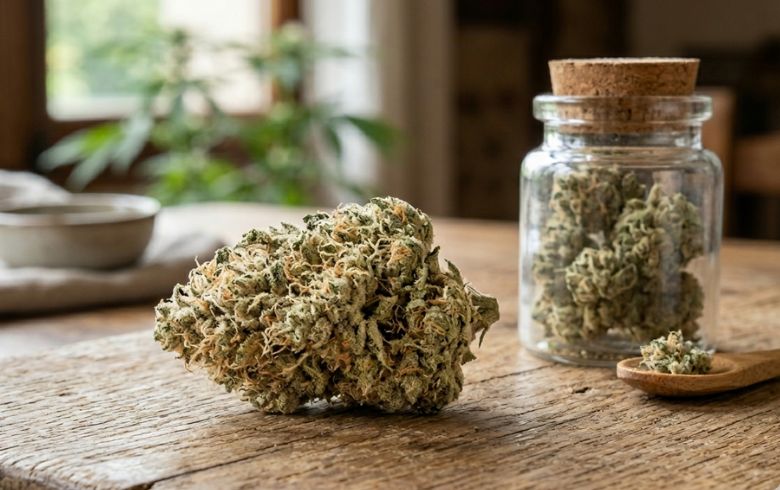
Week 5: In addition to seeing the buds grow, new ones will appear in other areas. The white hairs of the flowers will darken and turn brown or amber, whereas trichomes will become opaque; both events are signs that the harvest is approaching.

Advanced Flowering (pre-harvest)
Although this will depend on the chosen variety, most plants will be ready for harvest during this period. Among some of the actions taken during this time is root flushing, depending on the type of cannabis, this will be done about 2-3 weeks before harvest.
It is simple to do, as it simply involves stopping nutrient input and providing water with balanced pH. This removes salts and minerals from the soil, resulting in better buds with a more natural flavor, avoiding chemical nuances. Also, if fertilizers with a high concentration of salts are used during cultivation, it is advisable to have products such as salt cleaners available.
To determine when they have matured enough to be harvested, it is suitable to regularly observe the trichomes with a small microscope or magnifying glass. When they are still clear and transparent, it indicates that it is too early for harvest. Nevertheless, if they have an amber tone and are opaque, it means they contain a high percentage of THC and can be harvested.
To know how long it takes for buds to mature, it is important to understand the phases they go through and regularly monitor the trichomes. The ripening time will depend on the type of seed, although it usually ranges between 7 and 9 weeks.





 Add as preferred source in Google


