Personalized Attention +44 151 947 0713
 SHIPPING TO ALL

 9/10 Rating
 SALE TO MINORS PROHIBITED

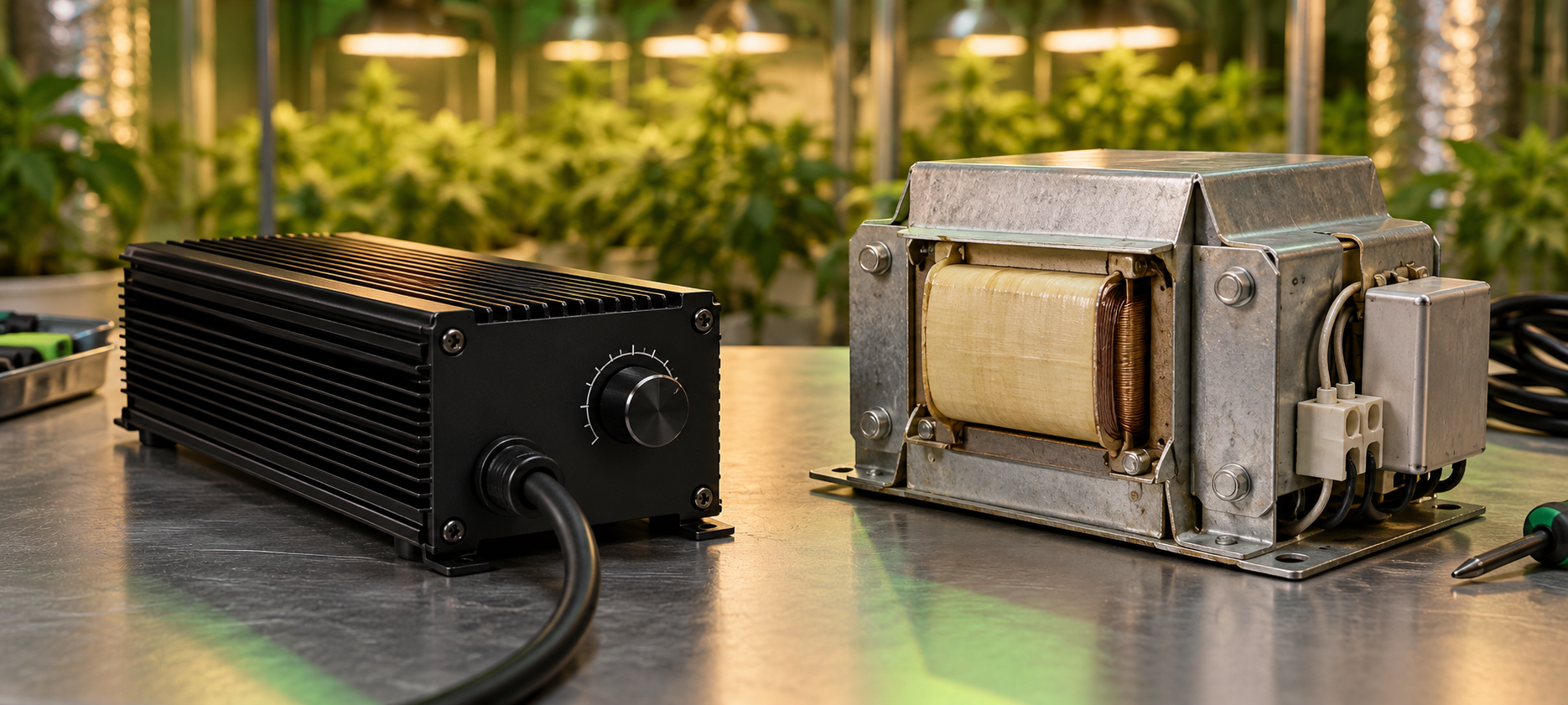
Electronic and magnetic ballasts have differences that go far beyond price. Their operation, power consumption, dimming capabilities, and heat generation can influence the lighting and temperature of an indoor grow.
When you set out to set up an indoor grow, many questions likely arise, such as the wattage of the bulbs, the type of extraction needed, or the most suitable lighting. However, the ballast is not always given the same attention.
The ballast is the device responsible for igniting and regulating the current received by discharge lamps, such as HPS and MH bulbs. Therefore, choosing a suitable model is important for the equipment to function correctly and safely.
Keep in mind: This comparison refers to HPS and MH lighting equipment. Modern LED systems use specific drivers and do not require this type of external ballast.
Electronic ballasts vs. magnetic ballasts
Although both types perform the same basic function, there are significant differences in their operation. Electronic ones use digital components to control the lamp, while magnetic ones work using coils and other electromagnetic components.

Advantages of the electronic ballast
- Electronic ballasts operate at a high frequency, offering more stable lighting and reducing bulb flickering.
- They generate less heat than magnetic ones, as they typically have lower energy losses during operation.
- Many models incorporate a power regulator, which allows the lighting intensity to be adapted to the different stages of the grow.
- They are usually lighter and quieter.
- They normally include protection systems against overheating, short circuits, or bulb issues.
- Some incorporate a Super Lumens function to slightly increase power during certain moments of flowering.
Their main drawback is that they usually have a higher purchase price. In return, they offer more regulation possibilities and more efficient lighting management.
Advantages of the magnetic ballast
Magnetic ballasts represent the simplest and most economical option for operating a compatible HPS or MH bulb.
- Their price is usually lower than that of an electronic ballast.
- They have simple operation and robust construction.
- They can be a sufficient alternative for small installations or tight budgets.
- Their repair or replacement is usually more economical.
As drawbacks, they generate more heat, weigh more, and normally work at a fixed power. They can also produce a slight hum and flicker that, although barely perceptible to the naked eye, can be observed through a camera.
Therefore, if several magnetic ballasts are used in the same room, it may be necessary to install them outside the grow space to avoid an excessive increase in temperature.
In general, the electronic ballast offers more stable lighting, less heat generation, and greater regulation possibilities. The magnetic one, on the other hand, stands out for its simplicity and lower initial price.
Electronic Ballasts
Lumatek dimmable electronic ballast: is one of the best-known models among indoor growers. It allows for power regulation to adapt the lighting to the different development phases of the plants.
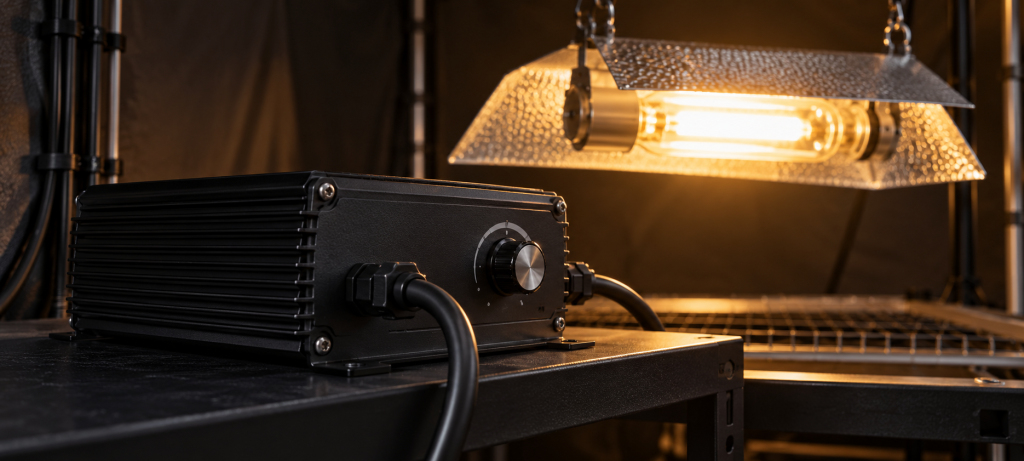
It is currently sold in different wattages, such as 400, 600, and 1000 W. The regulation positions depend on the chosen model, so it is advisable to check them before selecting the bulb.
This regulation allows for using a lower intensity during the early stages and increasing it progressively during growth and flowering. It also incorporates protection systems aimed at improving equipment safety.
Agrolite dimmable electronic ballast: is a more economical alternative among electronic models.
Its 600 W dimmable version allows for selecting different positions: 250 W, 400 W, 600 W, and Super Lumens. In this way, the power can be adapted to the different stages of the grow while always using a bulb compatible with the equipment and the selected power.
It can be used with HPS and MH lamps and incorporates protections against overheating, overloads, and short circuits.
Magnetic Ballasts
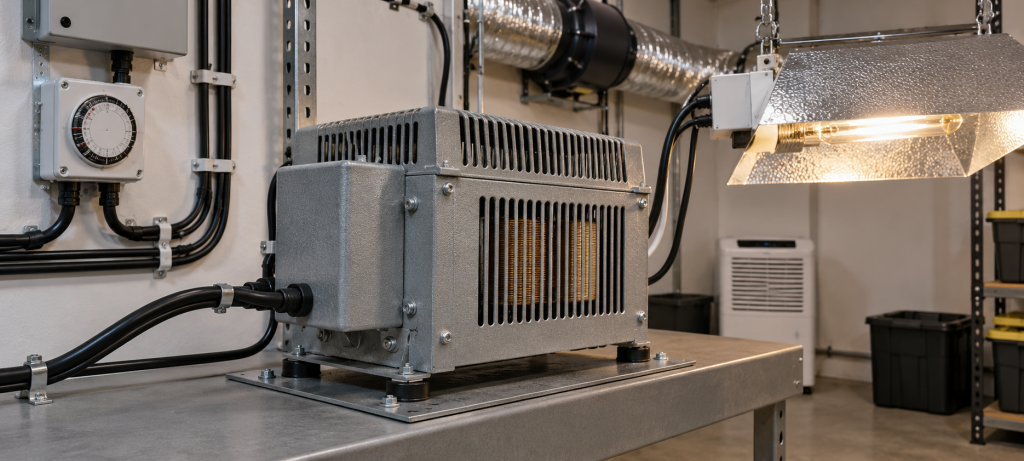
Agrolite Class 2 Ballast: This is a simple and economical magnetic ballast, available in different wattages depending on catalog stock. It includes the necessary wiring to facilitate its installation, an anchor plate, and a fire-resistant casing.
As with other magnetic ballasts, it generates more heat than an electronic model and does not allow for power regulation. Therefore, it must be installed in a ventilated place away from water, flammable materials, and walkways.
Which type of ballast to choose?
The choice will depend on the budget and the needs of the grow. For an occasional or small installation, a magnetic ballast can correctly fulfill its function as long as it is compatible with the bulb and placed in a ventilated area.
If you are looking to regulate power, reduce generated heat, and have better protection systems, it will usually be more interesting to use an electronic ballast. Its initial price is higher, but it provides greater flexibility during the different stages of the grow.
Before buying any of these devices, always check the compatibility between the ballast, the bulb wattage, and the type of lamp used. It is also recommended to follow the manufacturer’s instructions and not to handle the equipment while it is connected to the power supply.
If you are already clear about which one you need, check out all our grow ballasts.