Personalized Attention +44 151 947 0713
 SHIPPING TO ALL

 9/10 Rating
 SALE TO MINORS PROHIBITED


The airflow of a domestic extractor hood is the starting point for understanding how to properly ventilate an indoor grow space and maintain a stable environment for your plants.
Although the term is commonly associated with kitchens or homes, the principle for calculating airflow is exactly the same in a grow cabinet: efficiently renewing the air to control temperature, humidity, and odors.
Knowing how to calculate it accurately prevents common mistakes, unnecessary purchases, and issues during cultivation. In this guide, we explain the process step by step, clearly and applicable to any indoor grow.
Why airflow matters
Properly calculated ventilation is not just about “removing hot air.” The correct domestic extractor hood airflow allows you to create a stable environment where your plants can grow without stress.
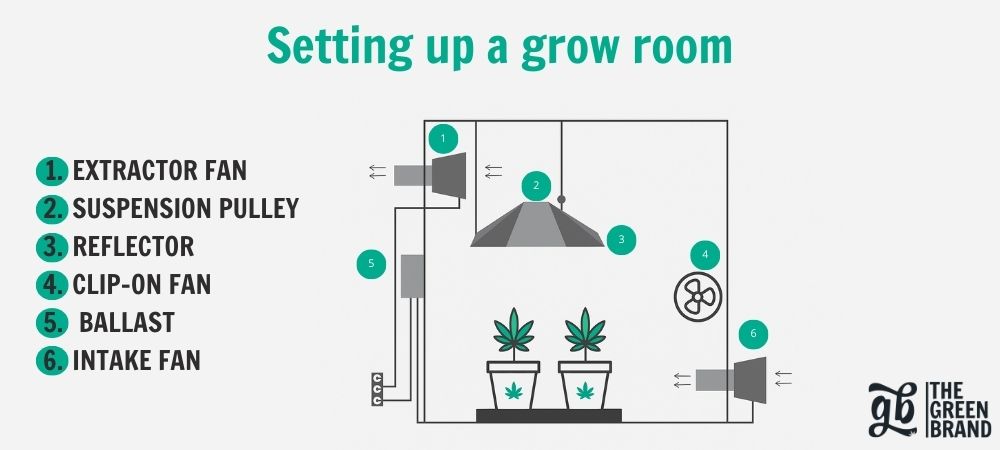
Problems caused by improper domestic extractor hood airflow
- Excess heat buildup inside the grow cabinet.
- High humidity and increased risk of mold.
- Stale air with insufficient CO₂ supply.
- Hard-to-control odors, even with a carbon filter.
- Higher electricity consumption due to overworking the extractor.
Basic concepts you need to know
- Airflow (m³/h): the amount of air the extractor moves in one hour.
- Volume: total space of the cabinet or grow room.
- Air changes per hour: how many times the air is replaced in an hour.
- Losses: actual reduction in airflow due to filters, ducts, and bends.
While users often focus on extractor power, they shouldn’t overlook installation, filters, duct curves, and tubing size, as these affect airflow as much as the motor itself.
Basic airflow calculation: The essential formula
Before choosing a domestic extractor hood or comparing models, it’s essential to know the minimum airflow your grow space requires. This calculation is based on two simple factors: the volume of the cabinet or room and the number of air changes needed to maintain stable conditions.
Using this basic formula provides a reliable reference value, which can then be adjusted according to lighting type, climate, or ventilation setup.
Step 1: Calculate the volume of your space
Measure the interior of the cabinet or room by multiplying its three dimensions—width, length, and height. This gives you the volume in cubic meters. Once you have the cubic volume, apply this formula:
Volume (m³) = length × width × height
Example: Cabinet 1.2 × 1.2 × 2 m = 2.88 m³
Step 2: Determine required air changes
In domestic ventilation, such as in kitchens, the standard is usually six to twelve air changes per hour. However, indoor cultivation requires much more.
Lighting, especially when on for many hours, produces constant heat, and plants need a continuous supply of fresh air to grow properly.
For this reason, indoor growers commonly use a much higher reference for domestic extractor hood airflow: renewing all the air in the cabinet once per minute. This translates into a simple formula that has become a standard in many grow shops and specialized guides.
Common grow shop rule:
Base airflow = Volume × 60 This ensures the air is renewed once per minute.
Example:
2.88 m³ × 60 = 172.8 m³/h
The multiplier 60 is not a fixed law. In setups with efficient LEDs and good ambient temperature, it may be sufficient, while in hot environments or with HPS lights, adjustments may be needed.
Adjusting the calculation to reality: System losses
One of the most common mistakes when selecting an extractor is relying solely on the formula’s number. The domestic extractor hood airflow specified by manufacturers is always theoretical, measured under ideal conditions with no resistance. In a real grow environment, this never happens because the air must pass through filters, ducts, and bends before exiting the space.
The first element that reduces airflow is the carbon filter. While essential for odor control, it introduces resistance, typically causing around a 20% loss. This is compounded by the extraction duct length: the longer and more flexible the duct, the harder the extractor has to work. Additionally, each elbow or curve further reduces the system’s real airflow.
For this reason, as a practical and safe rule, it’s recommended to increase the calculated domestic extractor hood airflow by 20% to 40%, depending on the complexity of the setup. In simple installations with short ducts and few bends, a 20% increase is usually sufficient. In longer setups or with multiple bends, the margin should be higher.
Following the previous example, if the base calculation is 172.8 m³/h, applying a 20% adjustment results in a recommended airflow of 207.4 m³/h, a much more realistic value for a stable indoor grow.
| Table 1 – Summary Formula for Domestic Extractor Hood Airflow | ||
|---|---|---|
| Element | Calculation | Result |
| Volume | Length × Width × Height | m³ |
| Base airflow | Volume × 60 | m³/h |
| Filter adjustment | × 1.2 | m³/h |
| Ducts & bends | × 1.3 – 1.6 | m³/h |
| Final choice | Higher model | More stability |
| Table 2 – Common Grow Cabinet Examples | |||
|---|---|---|---|
| Cabinet | Volume (m³) | Base airflow | With filter (+20%) |
| 60 × 60 × 160 | 0.58 | 35 m³/h | 42 m³/h |
| 80 × 80 × 180 | 1.15 | 69 m³/h | 83 m³/h |
| 100 × 100 × 200 | 2.00 | 120 m³/h | 144 m³/h |
| 120 × 120 × 200 | 2.88 | 173 m³/h | 207 m³/h |
Extractor and intake fan: How to balance them correctly
For a balanced ventilation system, the extractor’s airflow should always exceed the intake fan. This creates slight negative pressure inside the cabinet, helping the air exit where it should and allowing the carbon filter to work efficiently.
As a general guideline, many growers use an intake fan with about a quarter of the extractor’s airflow. This simple ratio works well in most standard cabinets and makes controlling the indoor climate easier.
Intake ≈ Extractor ÷ 4
This helps maintain slight negative pressure, key for odor control.
The recommended installation order is usually the same: Carbon filter → extractor → duct → outlet. Whenever possible, use short ducts with minimal bends.
Professional tips to fine-tune your system
Beyond the numbers, small details can make a big difference in system performance.
Duct diameter
A narrow duct restricts actual airflow. Always use the diameter recommended by the extractor.
Signs of insufficient extraction
- High temperature despite proper lighting.
- Odors escaping the cabinet.
- Humidity difficult to control.
Common solutions
- Power controller.
- Acoustic silencer.
- Reduce duct length and number of bends.
Checklist before buying your domestic extractor hood
- Exact cabinet dimensions.
- Lighting type (LED, HPS).
- Number of bends and duct length.
- Use of carbon filter.
- Typical ambient temperature.
With this information, the calculation of domestic extractor hood airflow for indoor cultivation is accurate and reliable.