Personalized Attention +44 151 947 0713
 SHIPPING TO ALL

 9/10 Rating
 SALE TO MINORS PROHIBITED


Cannabis regulation is no doubt one of the most polemic and intense debates worldwide nowadays. There are major conceptual, legal and penal differences regarding its medicinal and recreational use. Marijuana has been suffering persecution since time immemorial and it is still haunted by prejudice to this day; without taking into account the numerous therapeutic benefits availed by the scientific community.
All of these factors, along the existent diffuse Spanish legislation in relation to cannabis; have multiplied the existence of commercial growers and also the demand all over the Peninsula. Some associations have organized themselves to agree upon certain proposals; aimed at materializing the desired regulation of cannabis consumption and cultivation.
Cannabis Policies Study Group Regulation Proposals
The Cannabis Policies Study Group (GEPCA) has been working remarkably hard on a regulation system accredited by lawyers, psychiatrists and pharmacists from different Spanish regions. Xavier Arana, a doctorate of law and member of this organisation asserts that “cannabis has been, is and will be present in our society. In order to approach responsible consumption and reduce damages; it is important to consider rights and the free development of the personality as the main axis of regulation.
One of GEPCA objectives is to willingly offer youngsters cannabis related education in primary schools and in high schools; informing them of the therapeutic advantages or the possible secondary effects it could cause. Another one of their proposals is to authorize moderate crops; as long as the plants are for self-consumption and with a maximum of 6 plants per every 5 people.
They also propose the creation of a controlled market for growers that don’t gather the necessary conditions to grow a cannabis crop; which would consolidate the industry of raising and stabilizing marijuana genetics. The GEPCA also contemplates the regulation of cannabis clubs as these associations have approached responsible consumption and cultivation among people. These places would allow the growth of cannabis plants in a moderate and guided way in order to supply club members throughout the year.

Complete Cannabis Regulation in Spain
For the past few years, the vast majority of society are requesting a substantial change of the legal framework involving cannabis consumption and cultivation in Spain. Habitual consumers, either for recreational or medicinal purposes; as well as other key factors like pharmaceutical or dietitian companies and various judicial members, consider that an integral reform should take place over the coming years.
Judges have manifested on several occasions their disconformity with regulating through controversial rulings. It was publicly demonstrated with Sentence 484/2015 from September 7th that the debate about cannabis regulation is clearly acknowledged; its agora shouldn’t be in the Tribunals but in the General Courts. Despite the approval of different ordinances regulating cannabis associations by certain autonomous communities like the Basque Country, Navarra or Catalunya, an amendment of the Penal Code by the Parliament is still much needed. Therefore, knowing the willingness and the objectives of the different political parties is an essential task to figure if this debate enters their political and mediatic agenda.
The last barometer performed by the Sociological Investigation Center (CIS) on this matter, concluded that cannabis legalization would be approved by the majority of the population. In 2018, an opinion poll showed that 84% of society would agree with legalizing marijuana for medicinal purposes and 47% for recreational uses. Three years later, such percentages have increased to 90.1% and 49.7% respectively; which makes it obvious that there is a clear interest towards decriminalizing and regulating this substance.
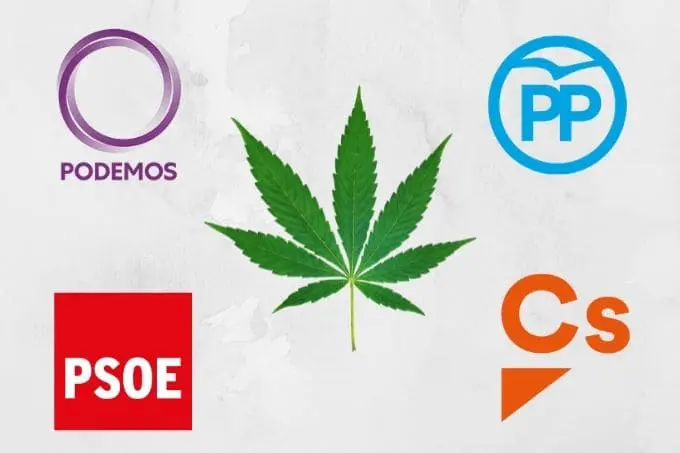
What do the main political parties reckon about cannabis regulation?
The main Spanish political parties have different positions regarding a hypothetical regulation of recreational and medicinal cannabis. While they are gradually advancing; it isn’t moving fast enough as to reach the so yearned consensual and controlled regularization in the near future.
At present, the disagreements of the Coalition Government that presides over Spain are well-known. PSOE (socialist party) is taking a cautious position; based on the non-existent scientific studies that prove the potential therapeutic benefits associated with cannabis. Despite the discordant opinions within left-wing parties regarding cannabis regulation; they advocate for a debate that includes the great majority of society without taking political interests into account.
On the other hand, Unidas Podemos, the second Spanish government party, and Esquerra Republica de Catalunya (Catalan left-wing party) are the only ones in Congress pretending an integral legal and penal marijuana reformulation in Spain. One of their objectives is to present a law proposal that establishes new legal frameworks regarding use, self-cultivation, exportation, importation, association regulations and cannabis education formation.
Partido Popular (known as PP, right-wing party) is the main opposition party and maintains a contrary and equidistant eagerness in this matter. Although they would consider further and deeper studies referencing cannabis therapeutic uses, they are completely uninterested about future law changes. Ciudadanos also reckons that the regulation of therapeutic cannabis is necessary. According to the current Castilla y León vice-president, “there is enough medical evidence to make its regularization a priority”. In 2017, the orange party (ciudadanos) presented a motion to the Congress. While it wasn’t approved, it did serve as a base to create a sub-commission that depended on the Congress Committee of Health Care with the intention of considering the regulation of such medicinal purposes.
International examples: Holland and Canada
Plenty of countries have regularized the consumption and cultivation of cannabis. Obviously, Holland, where marijuana is legal in coffee shops, is the most known one. However, another country to take as reference is Canada. This North American country permits the use of this substance and the possession of up to 30 dried grams,;as long as it comes from an authorized and licenced distributor.
The diverse positions of the Spanish political panorama predict a still complex scenario; it seems difficult to reach a point that satisfies the entire Parliament. Nevertheless, society’s will in conjunction with scientific investigations strengthen this movement that seeks the fair and well-deserved regulation of cannabis.