Personalized Attention +44 151 947 0713
 SHIPPING TO ALL

 9/10 Rating
 SALE TO MINORS PROHIBITED

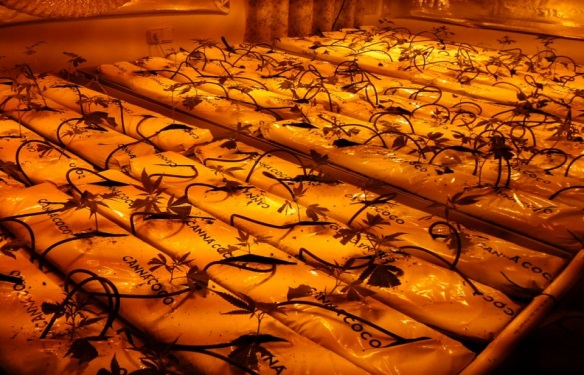
Growing marijuana in coco slabs is a simple and convenient alternative to other hydroponic systems. Coconut fiber offers a good balance between moisture retention and root aeration, while automated irrigation makes it easy to control water and nutrient intake.
Unlike some hydroponic systems, it is not necessary to keep the roots directly in a nutrient solution, although we must monitor parameters such as pH, EC, irrigation, and drainage to achieve a balanced crop.
What do we need to grow in coco slabs?
To set up a crop with coco slabs, we will mainly need:
- Canna Coco Slab, a substrate prepared for use on grow tables and drip irrigation systems.
- Slab pot with drainage elbows, specially designed to hold slabs and facilitate drainage.
- Drip irrigation system.
- Indoor grow kit, if we are going to grow indoors.
- SCROG net to control plant structure and support the branches.
- Specific fertilizers for coco.
- pH and EC meters to monitor the nutrient solution.
Canna Coco Slab
The Canna Coco Slab is made of coconut fiber and has dimensions of 100 × 15 × 7.5 cm, with a volume of approximately 24 liters. It is designed to be placed in a specific tray or pot, where you connect the drippers and place the cuttings or plants.
Its structure allows for a good combination of moisture and aeration around the roots, provided that irrigation and drainage are correctly adjusted.

Canna Coco Slabs
How does growing in coco slabs work?
One of the main characteristics of this system is that we are working with a medium that provides very few nutrients on its own. Therefore, the plants’ nutrition will depend mainly on the nutrient solution we add to the irrigation water.
This allows for greater control over nutrition, but it also makes it especially important to monitor pH and EC and follow the fertilizer manufacturer’s recommendations.
More space for roots
One of the advantages of slabs over traditional pots is that we have an elongated and shared volume of substrate, providing more horizontal space for root development.
This does not mean that the roots have unlimited space, but it can facilitate their expansion within the slab and make better use of the space available on the grow table.
Automated irrigation
Another great advantage is the possibility of installing a drip irrigation system. Once the reservoir is prepared with water and nutrients, we can distribute the solution evenly using the drippers.
This is especially practical for crops with multiple plants, as it avoids having to water them individually.
The importance of the irrigation system
For a slab crop to work correctly, the irrigation system must be well installed. It is recommended to use a suitable pump, filters, and quality drippers, and to periodically check for any obstructions.
The drippers must distribute the water evenly and the slab must have proper drainage. It is important to avoid both letting the coco remain completely dry and keeping it constantly saturated.
Slab pot with drainage elbows
This pot is specifically designed to work with coco or rockwool slabs and facilitates both their placement and the evacuation of excess water.
Good drainage is essential to maintain adequate conditions in the root zone and avoid problems derived from excess moisture.
Fertilization in coco slabs
When using coco, we must pay special attention to nutrition. We cannot treat it exactly the same as an enriched substrate, since nutritional needs are mainly covered through the irrigation water.
Therefore, in addition to monitoring pH and EC, we must use fertilizers suitable for coco crops and respect the recommended doses.
Canna Coco A+B
Canna Coco A+B is a nutrient base formulated specifically for coconut fiber crops. Its components are presented separately and are water-soluble, so they can be used in drip irrigation systems by following the manufacturer’s instructions.
It is an option especially associated with this type of crop, as it can be used both in slabs and in pots with coco.

Canna Coco A+B 1L
Advantages and aspects to consider
Growing in coco slabs offers several interesting advantages:
- It facilitates irrigation automation.
- It allows for precise control of nutrition.
- It provides a good balance between aeration and moisture.
- It offers a large volume of substrate for root development.
- It can be convenient when growing several plants.
- It allows combining coco with techniques like SCROG.
However, it also requires some attention. A poorly adjusted irrigation system, insufficient drainage, or an incorrectly prepared nutrient solution can cause root problems.
Controlling growth with SCROG
Plants grown in coco can develop rapidly when conditions are right. Therefore, controlling the plant’s structure is important, especially in indoor crops where height is limited.
A SCROG net can help us distribute the branches, make better use of the available surface, and provide support to the branches during flowering.
In this way, we can also maintain a more uniform canopy and make more efficient use of the grow lighting.
Is it better to grow in coco slabs than in hydroponics?
There is no universally better system. Coco slabs can be a good alternative for those looking for the advantages of growing with automated irrigation without working directly with roots in a hydroponic solution.
In addition, coco offers some water retention capacity and good aeration, which provides a different margin than other hydroponic systems.
The key is to adapt irrigation, nutrition, drainage, and lighting to the needs of the crop.
Conclusion
Growing in coco slabs is an interesting option for those who want to work with drip irrigation and have greater control over plant nutrition. With a good drainage system, an adequate nutrient solution, and regular monitoring of pH and EC, we can create a favorable environment for root development.
In addition, products such as the Canna Coco Slab, the Slab pot with drainage elbows, and Canna Coco A+B provide the basic elements to set up this type of cultivation system.