Personalized Attention +44 151 947 0713
 SHIPPING TO ALL

 9/10 Rating
 SALE TO MINORS PROHIBITED

There are too many causes that may affect cannabis crops such as infestations. High temperatures and infestations tend to go hand in hand when it comes to summer crops. One of the most common and difficult to get rid of are red spider mites. The survival and reproduction of red spider mites are influenced by different factors, including the temperature. Thus, we must know at what temperature do red spider mites die and how.
What are red spider mites?
The red spider mite, or Tetranychus urticae, is a species of plant-feeding mite of the family Tetranychidae that commonly affects plant crops such as cannabis plants. They can be found causing considerable damage in areas with slightly mild climates.
Red spider mite characteristics
Some of the characteristics to easily recognize them are:
- The adult red spider mite is small, it has a length of 0.5 mm (0.020 in), so it can only be identified when there’s a great number of them.
- In spring and summer, they can have different colors that may vary from yellow to light or dark green, red, brown or nearly black depending on the plant on which they feed.
- They’ve got two spots on their back, that’s why they are also known as two-spotted spider mites.
- They are usually found on the underside of the leaves.
- The females’ life cycle is about 20-28 days and 14 for males.
The natural habitat of red spider mites
The red spider mite is a warm and dry climate species. Its optimal temperature to quickly develop and reach a high rate of reproduction ranges 30-32ºC (86-89ºF), becoming a dangerous plague for crops. About 25-30ºC (77-86ºF) their reproduction slows down, but at what temperature do red spider mites die?
In extremely high or cold temperatures, red spider mites may suffer and even die. At temperatures below 10ºC (50ºF), they have discomfort and their development decreases. Below 0ºC (32ºF), they may die. However, it rarely happens in nature as red spider mites tend to look for warm refuges during winter.
On the other hand, extremely high temperatures may be harmful for red spider mites. At temperatures over 40ºC (104ºF), they suffer from heat stress and may die, especially if these climatic conditions remain for a prolonged period.
Environmental factors that affect red spider mites
Apart from temperature, there are other environmental factors that affect red spider mites survival and reproduction. Humidity, for example, is another important factor. A relative humidity below 60% may reduce their survival. Thus, we must maintain our crops optimal humidity levels to avoid red spider mite infestation.
Another key element in regards to red spider mites survival and reproduction is the access to food. They feed on plants, so they can become a challenging plague in many different crops apart from cannabis, such as tomatoes, peppers and strawberries.
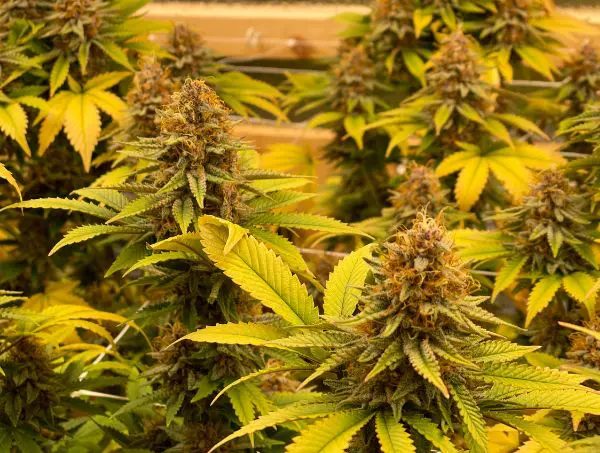
A great red spider mite population may cause leaf damages, such as losing its green color, deforming and early leaf fall. The first notable symptoms are yellow-whitish spots, especially around the midribs. As a result, the quality and the amount of the crop can be reduced.
Red spider mite management
There are different ways to control the population of red spider mites in crops. One of the most common methods is the use of pesticides. However, it must be taken into account that some of them may have a negative impact on the environment and other insect species.
Another system to control their population is using biological control techniques introducing predatory mite species such as Phytoseiulus persimilis. These insects can feed on red spider mites and help us to reduce their population, so it’s also an effective and a more environmentally friendly method.
On the other hand, we can place sticky traps in our crops in order to draw red spider mites and help us to reduce their population. We can also prune the affected leaves and underbrushes as red spider mites usually nest there. There are many products for plague control such as Spider Boom by Boom nutrients, specially created to deal with these insects.
The red spider mite plague commonly damages plant crops. Temperature is an important factor that may affect the survival and reproduction of this insect, as well as humidity and access to food. In order to fight against them, it is important to know at what temperature do red spider mites die.




 Add as preferred source in Google